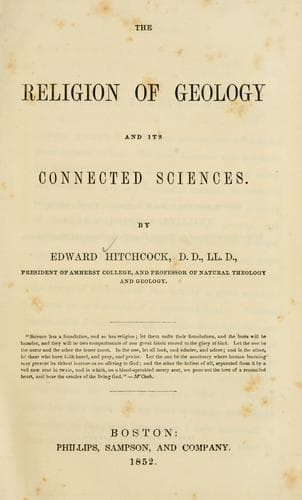
The Religion of Geology and Its Connected SciencesHitchcock, Edward
Religion
The Religion of Geology and Its Connected Sciences
Hitchcock, Edward
Bible and geology; Religion and science
It will be said, perhaps, that the good resulting to the whole from even
the most severe of these sufferings, overbalances the evil, and therefore
they are indications of benevolence in such a world as ours. True, as
things are, this may be so. But the question is, Why is there such a
constitution given to nature as made it necessary to introduce disease,
accident, and death? Would not unmixed benevolence have conferred the
good, but have withheld the evil? Had there not been something in man's
character requiring the discipline of trials, would pure benevolence have
sent them? At least, we should suppose that they might all have been
avoided by prudence and virtue. Why should benevolence make such severe
drawbacks upon the happiness even of the virtuous, if something were not
radically wrong in the human constitution?
Thirdly. The great sterility of so large a part of the earth, and the
necessity of severe bodily labor to secure sustenance from it, show us
that the benevolence exhibited in nature and in man's condition is not
unmixed. Though some limited regions are exuberantly fertile, the larger
part of the earth yields up even a mere sustenance only after the severest
labor. And the vast majority of the race can do nothing more than to
obtain food for the body. The artificial state of most societies does,
indeed, keep the lower classes much more depressed than a better state of
the world would bring them into; but at the best, nature unites with
revelation in attesting the truth of the sentence passed upon man--_In the
sweat of thy face shalt thou eat thy bread._
Nor is this necessity for severe labor confined to the cultivation of the
earth, but extends to all kinds of human pursuits. Success, as a general
fact, can be secured only by vigorous industry; and often, in spite of
their most honest and persevering efforts, men fail of securing even a
competence for the support of themselves and their dependants.
Some will say that all this arises from a necessity in the very nature of
the case. But does not such a view limit the divine power and wisdom?
Could not God have prepared a world more paradisiacal than the present,
where the earth should spontaneously yield her fruits, and pour out her
hidden treasures at man's feet? Who will deny this? Why, then, has he not
done it? Because obviously a race so prone to evil as man, so incapable of
maintaining his integrity in the lap of ease and indulgence, needs all
this severe discipline to keep him where he ought to be. Here, then, we
see a reason why God must mingle seeming severity with benevolence.
The same thing is seen, in the fourth place, in the confined and depressed
condition of the human mind in this world, and in the multiplied obstacles
in the way of its cultivation and enlargement.
Public-domain text, read in full here on John Shaqi.
Reviews
Reviews
No reviews yet
Be the first to share your thoughts on this work.
Elsewhere in the archive
Join the Discussion
Join the discussion
Sign in to leave a comment or review.
Sign InorCreate an account