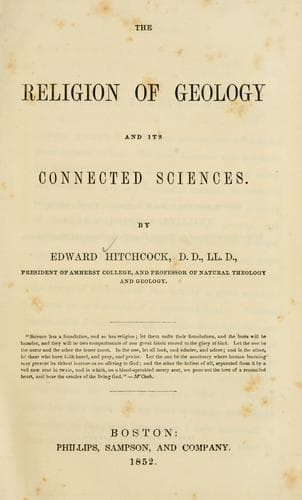
The Religion of Geology and Its Connected SciencesHitchcock, Edward
Religion
The Religion of Geology and Its Connected Sciences
Hitchcock, Edward
Bible and geology; Religion and science
In thus representing incidental effects as indicative of the feelings of
the Deity, I may seem to contradict my reasoning under the first head,
where I gave, as proof of God's benevolence, the fact that the direct
object of every contrivance is beneficial, and evil only incidental. But I
did not mean to intimate that the incidental effects of a contrivance are
no index of the feelings of its author, but only that the direct effects
show more clearly than the incidental what are his wishes and intentions,
especially if the former are the most numerous, important, and striking.
Still, incidental effects are never without an object; and where they are
evil, as in the case supposed, they indicate other feelings towards men,
in the divine mind, than unmixed benevolence. For it is a strange
limitation of God's wisdom and power to say, as some do, that the evils
could not be prevented.
It may be said, however, that if men only conform to the laws of nature,
they will escape all the evils they suffer. On the other hand, I
maintain,--and this constitutes my second argument to show that the divine
benevolence is not unmixed,--I maintain that the highest virtue and the
most consummate prudence cannot avoid all the evils of life.
Such prudence and virtue will not secure any one against many destructive
natural agencies and operations to which he is exposed. Miasms productive
of fatal disease may contaminate the atmosphere we breathe, unperceived by
us; poison may exist in the food which we take as our necessary
sustenance; the mechanical violence of the elements, or of gravity, may
crush us; the lightning may smite us to the earth; the wild beast may rush
from his unnoticed lair as we pass; or the deadly insect, or serpent, may
inject its poison into our blood at an unexpected moment; or the floods
may overwhelm, or the fire consume us.
Now, although prudence and virtue may defend us against many evils, they
afford no security against such as I have named, in very many instances.
We are often ignorant of their existence or proximity till we become their
victims, and suffering, often intense, is the consequence. Indeed, the
greatest of all physical evils--I mean death--is as sure to visit every
son and daughter of Adam as any event can be; and nothing but insanity, or
its religious synonyme, fanaticism, has ever pretended to be proof against
disease and death. You cannot, indeed, point out any particular organ or
agency, whose direct object is to produce disease and death; but they are
nevertheless the inevitable result of organic operations and agencies in
such a world as this.
Public-domain text, read in full here on John Shaqi.
Reviews
Reviews
No reviews yet
Be the first to share your thoughts on this work.
Elsewhere in the archive
Join the Discussion
Join the discussion
Sign in to leave a comment or review.
Sign InorCreate an account