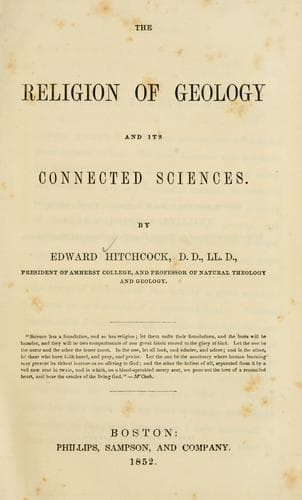
The Religion of Geology and Its Connected SciencesHitchcock, Edward
Religion
The Religion of Geology and Its Connected Sciences
Hitchcock, Edward
Bible and geology; Religion and science
Such are the wonderful contrivance, adaptation, and design which the
material world every where exhibits. But the geologist carries us back
through periods of immense antiquity, and digs out from the deep strata
evidences of other systems of organic life, which have flourished and
passed away; other economies, which have existed on the globe anterior to
the present. And how was it with these? Had they any relation to the
existing system? Were they governed by different laws, or are they all but
parts of one great and harmonious system, embracing the whole of the
earth's past duration? We could not decide these questions beforehand; but
geology brings to light unequivocal evidence that the latter supposition
is the true one; that is, in the language of the poet,--
"All are but parts of one stupendous whole,
Whose body nature is, and God the soul."
To present the evidence of this conclusion will be my object in this
lecture.
_In the first place, the laws of chemistry and crystallography,
electricity and magnetism, have ever been the same in all past conditions
of the earth._
Chemistry has attained to such a degree of perfection that the analyst
can now determine the composition of the various vegetable, animal, and
mineral substances which he meets, with an extreme degree of accuracy. In
many instances, he can do this in two ways. He can always separate the
elements which exist in a compound, and ascertain their relative quantity;
and this is called _analysis_. And sometimes he can take those elements
and cause them to unite, so as to form a particular compound; and this is
called _synthesis_. By these methods he has ascertained that, amid the
vast variety of substances in nature, there are only about sixty-four
which cannot be reduced to a more simple form, and are therefore called
_elements_, or simple substances. Now, the chemist finds that, when these
elements unite to form compounds, certain fixed laws are invariably
followed. They combine in definite quantities, which are always the same,
or some multiple of the same weight; so that each element has its peculiar
and invariable combining weight; and it cannot be made to combine in any
other proportion. You may mix two or more elements together in any
proportion, but it is only a certain definite quantity of each that will
combine, while the rest will remain in excess. Hence the same compound
substance, from whatever part of the world it comes, or under however
diverse circumstances produced, consists of the same ingredients in the
same proportion. These laws are followed with mathematical precision, and
we have reason to believe that the same compound substance, produced in
different parts of the world, never differs in its composition by the
smallest conceivable particle. Indeed, with the exception of the planetary
motions and crystallography, chemical combination is the most perfect
example of practical mathematics to be found in nature.
Public-domain text, read in full here on John Shaqi.
Reviews
Reviews
No reviews yet
Be the first to share your thoughts on this work.
Elsewhere in the archive
Join the Discussion
Join the discussion
Sign in to leave a comment or review.
Sign InorCreate an account