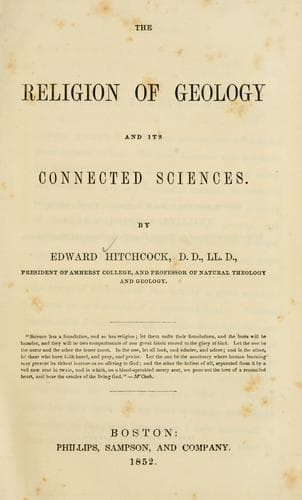
The Religion of Geology and Its Connected SciencesHitchcock, Edward
Religion
The Religion of Geology and Its Connected Sciences
Hitchcock, Edward
Bible and geology; Religion and science
Such are the laws which the chemist finds invariably to regulate all the
changes that now take place in the constitution of bodies. What evidence
is there that the same laws have ever prevailed? In the rocks we have
chemical compounds, produced in all ages of the world's history, since
fire and water began to form solid masses. Now, these may be, and have
been, analyzed; and the same laws of definite proportion in the
ingredients, which now operate, are found to have controlled their
formation. The oldest granite and gneiss, which must have been the
earliest rocks produced, are just as invariable in their composition as
the most recent salt formed in the laboratory. And the same is true of the
silicates, the carbonates, the sulphates, the oxides, chlorides,
fluorides, and other compounds which constitute the rocks of different
ages. We never find any produced under the operation of different laws.
Now, the almost invariable opinion among chemists is, that the reason why
the elements unite thus definitely is, that they are in different
electrical states, and therefore attract one another. Hence the most
important laws of electricity have been coeval with those of chemistry;
indeed, they are identical; nor can we doubt, if such be the fact, that
every other electrical law has remained unchanged from the beginning. And
from the intimate connection, if not complete identity, between
electricity and magnetism, it is impossible to doubt that the laws which
regulate the latter are of equal antiquity with those of the former.
Indeed, we find evidence in all the rocks, especially those which are
prismatic and concretionary, of the active influence of galvanism and
electro-magnetism in their production.
The reasoning is equally decisive to prove the unchanging character of the
laws which regulate the formation of crystals. The chemist finds that the
same substance, when it crystallizes, invariably takes the same
geometrical forms. The nucleus or primary form, with a few exceptions, of
no importance in the present argument, to which all these secondary forms
may be reduced by change, is one particular solid, with unvarying angles;
and all the secondary forms, built upon the primary, correspond in their
angles. In short, in crystallography we have another example of perfect
practical mathematics, as perfect as the theory.
Now, the oldest rocks in the globe contain crystals, and so do the rocks
of all ages, sometimes of the same kind as those produced in the chemist's
laboratory. And they are found to correspond precisely. It matters not
whether they were the produce of nature's laboratory countless ages ago,
or of the skill of the nineteenth century,--the same mathematics ruled in
their formation with a precision which infinite wisdom alone could secure.
_In the second place, the laws of meteorology have ever been the same as
at present._
Public-domain text, read in full here on John Shaqi.
Reviews
Reviews
No reviews yet
Be the first to share your thoughts on this work.
Elsewhere in the archive
Join the Discussion
Join the discussion
Sign in to leave a comment or review.
Sign InorCreate an account