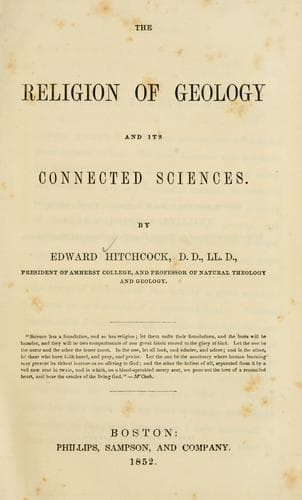
The Religion of Geology and Its Connected SciencesHitchcock, Edward
Religion
The Religion of Geology and Its Connected Sciences
Hitchcock, Edward
Bible and geology; Religion and science
But though the nature of the agencies above considered has never changed,
the intensity or amount of their action has varied; how much is a point
not yet settled among geologists. Some regard that intensity, as it has
existed during the present or alluvial period, as a standard for all
preceding periods; that is, the intensity of these forces has never varied
more during any period of the earth's history than it has since the
alluvial period commenced. Most geologists, however, regard this as an
extreme opinion, and think they see evidence in geology of a far greater
intensity in these agencies in past periods than exists at present. They
think they have proof that the world was once only a molten mass of
matter, and some evidence that previously it was in a state of vapor. They
believe that vast mountains, and even continents, have sometimes been
thrown up from the ocean's bed by a single mighty paroxysmal effort; and
such effects they know to be far greater than the causes of change now in
operation can produce, without a vast increase of their intensity. But
this question need neither be discussed nor decided for the sake of my
present argument, since my object is to prove an identity in the nature
and laws, not in the intensity, of geological agencies.
_In the fourth place, the laws of zoology and botany have always been the
same on the globe._
An examination of the animals now living, amounting to some hundred
thousand species, perhaps to one or two millions, shows that they may be
arranged in four great classes. The first class embraces the vertebral
animals, distinguished by having a vertebral column, or back-bone, a
regular skeleton, and a regular nervous system. It comprehends all the
quadrupeds and bipeds, with man at their head, and is much superior to all
other classes in complexity of organization and strength of the mental
powers. The second class embraces the mollusks, or animals inhabiting
shells. They are destitute of a spinal marrow, and for the most part their
muscles are attached to the external covering, called the shell, although
this shell is sometimes internal. The third class are called articulated
animals, having envelopes connected by annulated plates, or rings. It
includes such animals as the lobster, bloodsucker, spider, and insects
generally. The fourth class have a radiated structure, and often resemble
plants, or their habitation is a stony structure. Hence they are sometimes
called zoophytes, which means _animal plants_; or lithophytes, which means
_stony plants_. They swarm in the ocean, and some of them build up those
extensive stony structures called coral reefs.
Public-domain text, read in full here on John Shaqi.
Reviews
Reviews
No reviews yet
Be the first to share your thoughts on this work.
Elsewhere in the archive
Join the Discussion
Join the discussion
Sign in to leave a comment or review.
Sign InorCreate an account