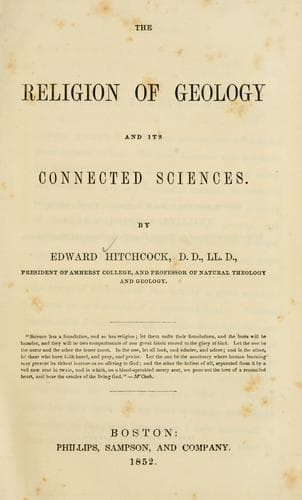
The Religion of Geology and Its Connected SciencesHitchcock, Edward
Religion
The Religion of Geology and Its Connected Sciences
Hitchcock, Edward
Bible and geology; Religion and science
Now, if we examine the descriptions of the organic remains in the rocks,
we find that in all ages of the world these four great classes of animals
have existed. But in the earliest times, the three last classes--the
mollusks, the articulated, and the radiated tribes--vastly preponderated,
while the vertebral class had only a few representatives; and it is not
till we rise as high as the new red sandstone, that we meet with any,
except fishes, save a few batrachians in the old red sandstone, and the
carboniferous group, detected alone by their tracks. Then the reptiles
began to appear in abundance, with tortoises and enormous birds of a low
organization, but no mammiferous animal is found, until we reach the
oolite; and scarcely any till we rise to the tertiary strata, when they
became abundant; but not so numerous as at present, though for the most
part of larger size. Thus we find that the more perfect animals have been
developed gradually, becoming more and more complex as we rise on the
scale of the rocks. But in the three other classes, there does not appear
to have been much advance upon the original types, although in numbers and
variety there has been a great increase.
The plants now growing upon the globe, amounting probably to nearly one
hundred thousand species, are divided into two great classes, by a very
decided character. Some of them have distinct flowers, and others are
destitute of them. The former are called phenogamian, or flowering plants;
and the latter cryptogamian, or flowerless plants.
At present, the flowering plants very much predominate in the flora of
every country. But in the earliest periods of organic existence, the
reverse was the case. We find, indeed but very few flowering plants, and
these of a character somewhat intermediate between flowering and
flowerless; such as the coniferae and cycadeae, including the pine tribe. A
few palms appeared almost as early, and some other monocotyledons. But
most of the dicotyledons did not appear till the tertiary period, where
more than two hundred species have been found. Of the three hundred
species found in and beneath the carboniferous group, two thirds are tree
ferns, or gigantic equisetaceae. More than one third of the entire flora of
the secondary formation consists of cycadeae; whereas, this family of
plants forms not more than the two thousandth part of the existing flora.
In short, we find the more perfect plants as well as animals to be few in
the earliest periods, and to have been gradually introduced up to the
present time. But as to the flowerless plants, most of them seem to have
been as perfect at first as they now are.
Public-domain text, read in full here on John Shaqi.
Reviews
Reviews
No reviews yet
Be the first to share your thoughts on this work.
Elsewhere in the archive
Join the Discussion
Join the discussion
Sign in to leave a comment or review.
Sign InorCreate an account