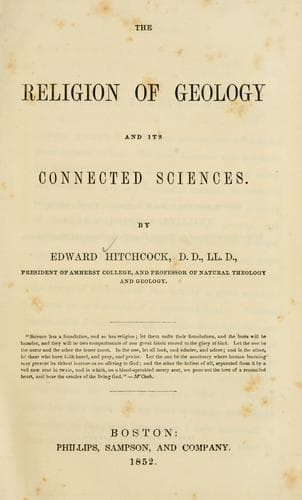
The Religion of Geology and Its Connected SciencesHitchcock, Edward
Religion
The Religion of Geology and Its Connected Sciences
Hitchcock, Edward
Bible and geology; Religion and science
These facts teach us conclusively that the outlines of organic life on the
globe have always been the same; that the great classes of animals and
plants have always had their representatives, and that the variations
which have been introduced, have been merely adaptations to the varying
condition of the earth's surface. The higher and more complex natures,
both of animals and plants, were not introduced at first, because the
surface was not adapted to their existence; and they were brought in only
as circumstances, favorable to their development, prepared the way.
There is another fact of great interest on this subject. Even a cursory
examination of the animals and plants now on the globe, shows such a
gradation of their characters that they form a sort of chain, extending
from the most to the least perfect species. But we see at once that the
links of this chain are of very unequal length; or, rather, that there are
in some instances wide intervals between the nearest species, as if one or
more links had dropped out. How remarkable that some of these lost links
should be found among the fossil species! I will refer to a few examples.
Among existing animals no genera or tribes are more widely separated than
those with thick skins, denominated pachydermata; such as the rhinoceros
and the elephant. But among the fossil animals of the tertiary strata,
this tribe of animals was much more common; and many of them fill up the
blanks in the existing families, and thus render more perfect and uniform
the great chain of being which binds together into one great system the
present and past periods of organic life.
A similar case occurs among fossil plants. In tropical climates we find a
few species--not much over twenty--of a singular family of plants, the
cycadeae connecting the great families of coniferae, or dicotyledons, with
the palms, which are monocotyledonous, and the ferns, which are
acotyledonous. The chasm, however, between those great and dissimilar
classes of plants is but imperfectly filled by the few living species of
cycadeae. But of the fossil species hitherto found above the coal
formation, almost one half are cycadeae; so that here, too, the lost links
of the chain are supplied.
"Facts like these," says Dr. Buckland, "are inestimably precious to the
natural theologian, for they identify, as it were, the Artificer, by
details of manipulation throughout his works. They appeal to the
physiologist, in language more commanding than human eloquence; the voice
of very stocks and stones, that have been buried for countless ages in the
deep recesses of the earth, proclaiming the universal agency of one
all-directing, all-sustaining Creator, in whose will and power these
harmonious systems originated, and by whose universal providence they are,
and have at all times been, maintained."--_Bridgewater Treatise_, vol. i.
p. 502.
Public-domain text, read in full here on John Shaqi.
Reviews
Reviews
No reviews yet
Be the first to share your thoughts on this work.
Elsewhere in the archive
Join the Discussion
Join the discussion
Sign in to leave a comment or review.
Sign InorCreate an account