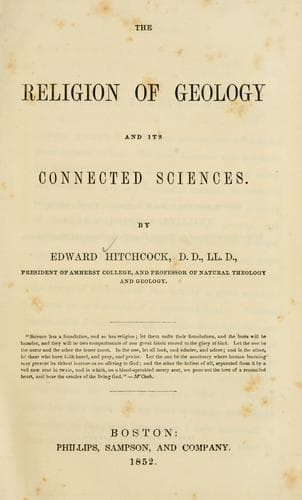
The Religion of Geology and Its Connected SciencesHitchcock, Edward
Religion
The Religion of Geology and Its Connected Sciences
Hitchcock, Edward
Bible and geology; Religion and science
No less certain are we that the processes of digestion and assimilation
have ever been unchanged. We find the same organs for these purposes as in
existing animals, viz., the mouth, the stomach, the intestines, and the
blood-vessels, as the coprolites and the cololites abundantly testify. We
infer, therefore, with great confidence, the existence of gastric juice
and bile for completing the transformation of the food into blood. Indeed,
the discovery by a lady (Miss Mary Anning, of England) of that singular
secretion from which the color called _India ink_ is prepared, with the
ink-bag of the sepia, or loligo, in a petrified state, shows that the
process of secretion existed in these ancient animals; and when we find
that in all respects their structure was like that of existing animals,
although some of the softer vessels have not been preserved, we cannot
doubt but the entire process of digestion, and the conversion of blood
into bone, nerve, and muscle, was precisely the same as it now is.
In the fact, also, that we find in fossil specimens organs of respiration,
such as lungs, gills, and trachea, we learn that the process of a
circulation of blood, and its purification by means of the oxygen of the
atmosphere, have never varied. Animal heat, too, dependent as it is
essentially upon this oxygenating process, was always derived from the
same source as at present.
The perfectly preserved minute vessels of vegetables enable us, by means
of the microscope, to identify them with the plants now alive; and they
prove, too, incontestably, that the nourishment of vegetables has always
been of the same kind, and has been converted into the various proximate
principles of plants by the same processes.
Again. We have evidence that these ancient animals possessed the same
senses as their congeneric races now on the globe. We have one good
example in which that most delicate organ, the eye, is most perfectly
preserved. It is well known that the visual organ of insects and of
crustaceans is composed of a multitude--often several hundreds or
thousands--of eyes, united into one, so as to serve the purpose of a
multiplying glass; each eye producing a separate image of the object
observed. Such an eye had the trilobite. Each contained at least four
hundred nearly spherical lenses on the surface of the cornea, united into
one organ; revealing to us the interesting fact, that the relations of
light to animal organization were the same in that remote era as they now
are.
Public-domain text, read in full here on John Shaqi.
Reviews
Reviews
No reviews yet
Be the first to share your thoughts on this work.
Elsewhere in the archive
Join the Discussion
Join the discussion
Sign in to leave a comment or review.
Sign InorCreate an account