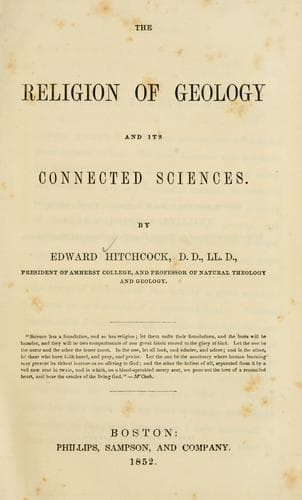
The Religion of Geology and Its Connected SciencesHitchcock, Edward
Religion
The Religion of Geology and Its Connected Sciences
Hitchcock, Edward
Bible and geology; Religion and science
But I need not multiply proof of the functional identity of organic nature
in all ages. It may, however, be inquired, how this identity, as well as
that of anatomical structure, is reconciled with the great anomalies, both
in size and form, which have confessedly prevailed among ancient animals.
Compare the plants and animals which now occupy the northern parts of the
globe with those which flourished there in the remote periods of
geological history, and can we believe them to be portions of one great
system of organic nature?
Compare, for instance, the thirty or forty species of ferns now growing to
the height of a few inches, or one or two feet, in Europe and this
country, with the more than two hundred species already dug out of the
coal mines, many of which were forty to forty-five feet in height; or the
diminutive ground pines, and equiseta, now scarcely noticed in our
forests, with the gigantic lepidodendron, sigillaria, calamites, and
equiseta, of the carboniferous period; and who will not be struck with the
great difference between them?
Or go to Germany, and imagine the bones of the dinotherium to start out of
the soil, and become clothed with flesh and instinct with life. You have
before you a quadruped eighteen feet in length, and of proportional
height, much larger than the elephant, and with curved tusks reaching two
or three feet below its lower jaw, while no other living animal would be
found there larger than the ox, or the horse--mere pygmies by the side of
such a monster, and evidently unfit to be his contemporaries.
Again. Let the megatherium be brought back to life on the pampas of South
America, and you have an animal twelve feet long and eight feet high, with
proportions perfectly colossal. Its fore feet were a yard long, its thigh
bone three times thicker than that of the elephant, its width across the
haunches five feet, its spinal marrow a foot in diameter, and its tail,
where it was inserted into the body, two feet in diameter. What a giant in
comparison with the sloth, the anteater, and the armadillo, to which it
was allied by anatomical structure!
Still more unequal in size, as compared with living batrachians, was the
labyrinthidon, once common in England and Germany, if, indeed, the tracks
on sandstone were made by that animal. It was, in fact, a frog as large as
an ox, and perhaps as large as an elephant. Think of such animals swarming
in our morasses at the present day!
But coming back from Europe, and turning our thoughts to the animals that
trod along the shores of the estuary that once washed the base of Mount
Holyoke, in New England, we shall encounter an animal, probably of the
batrachian family, of more gigantic proportions. It was the _Otozoum
Moodii_, a biped, with feet twenty inches long, more than twice the size
of those of the labyrinthidon; yet its tracks on the imperishable
sandstone show that such a giant once trod upon the muddy shore of that
ancient estuary.
Public-domain text, read in full here on John Shaqi.
Reviews
Reviews
No reviews yet
Be the first to share your thoughts on this work.
Elsewhere in the archive
Join the Discussion
Join the discussion
Sign in to leave a comment or review.
Sign InorCreate an account