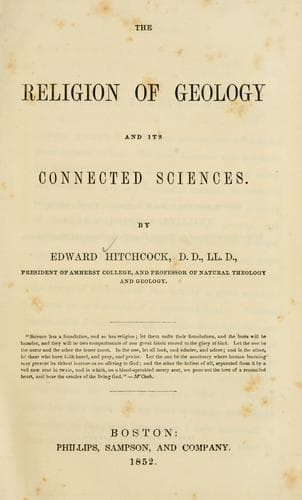
The Religion of Geology and Its Connected SciencesHitchcock, Edward
Religion
The Religion of Geology and Its Connected Sciences
Hitchcock, Edward
Bible and geology; Religion and science
"The fiend,
O'er bog, or steep, through straight, rough, dense, or rare,
With head, hands, wings, or feet pursues his way,
And swims, or sinks, or wades, or creeps, or flies."
Now, when the details of such facts are brought before us, it is very
natural to feel that it is the history of monsters, and that the
Centaurs, the Gorgons, and Chimeras of the ancients, are no more unlike
existing animals than these resurrections from the rocks. But further
examination rectifies our mistake, and we recognize them as parts of one
great system. All the peculiarities of size, and structure, and form,
which we meet, we find to be only wise and benevolent adaptations to the
different circumstances in which animals have been placed. The gigantic
size of many of them, compared with existing races, may be explained by
the tropical, or even ultra tropical character of the climate; and not a
single anomaly of structure and form can be pointed out, which did not
contribute to the convenience and happiness of the species, in the
circumstances in which they were placed. It is our ignorance and narrow
views alone that give any of them the aspect of monsters. Listen to the
opinion of Sir Charles Bell, one of the ablest of modern anatomists. "The
animals of the antediluvian world," says he, "were not monsters; there is
no _lusus_, or extravagance. Hideous as they appear to us, and like the
phantoms of a dream, they were adapted to the condition of the earth when
they existed." "Judging by these indications of the habits of the animals,
we acquire a knowledge of the condition of the earth during their period
of existence; that it was suited at one time to the scaly tribe of the
lacertae, with languid motion; at another, to animals of higher
organization, with more varied and lively habits; and, finally, we learn
that, at any period previous to man's creation, the surface of the earth
would have been unsuitable to him."--_Bridgewater Treatise_, pp. 35 and
31.
A similar view is given of this subject by England's geological poet,
(Rev. Mr. Wilks,) in whose playful verses we find more of true science and
just inference than in many a ponderous tome of grave prose. In one of
his poems he says,--
Public-domain text, read in full here on John Shaqi.
Reviews
Reviews
No reviews yet
Be the first to share your thoughts on this work.
Elsewhere in the archive
Join the Discussion
Join the discussion
Sign in to leave a comment or review.
Sign InorCreate an account