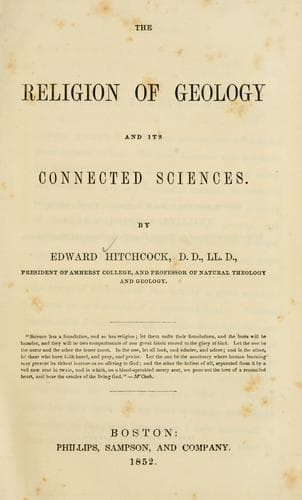
The Religion of Geology and Its Connected SciencesHitchcock, Edward
Religion
The Religion of Geology and Its Connected Sciences
Hitchcock, Edward
Bible and geology; Religion and science
Along that same shore, also, enormous struthious birds moved in flocks,
making strides from three to five feet long, with feet eighteen inches
long, lifting their heads, it may be, from twelve to eighteen feet above
the ground, surpassing, as it appears, even the gigantic dinornis of New
Zealand, now that the feet of the latter have been discovered. I refer to
the _Brontozoum giganteum_, whose tracks are so common on the new red
sandstone of the Connecticut valley. What dwarfs are we in comparison, who
now consider ourselves lords of that valley!
Still more remarkable for peculiarities of structure was the tribe of
saurians, which were once so numerous in the northern parts of Europe and
America. The ichthyosaurus, a carnivorous marine reptile, sometimes thirty
feet long, had the snout of a porpoise, the teeth of a crocodile, the head
of a lizard, the vertebrae of a fish, the sternum of an ornithorhynchus,
and the paddles of a whale. Those paddles, corresponding to the fins of a
fish, or the web feet of water birds, were composed, each of them, of more
than one hundred bones. In short, we find in this animal a combination of
mechanical contrivances, which are now found among three distinct classes
of the animal kingdom. Its eye, also, having an orbital cavity, in one
species, of fourteen inches in its longest diameter, was proportionally
larger than that of any living animal.
The plesiosaurus had the general structure of the ichthyosaurus; but its
neck was nearly as long as its whole body--longer, in proportion to its
size, than even that of the swan.
The iguanodon was an herbivorous terrestrial reptile that formerly
inhabited England. It approaches nearest in structure to the iguana, a
reptile four or five feet long, inhabiting the marine parts of this
continent. Yet the iguanodon was thirty feet long, with a thigh six feet,
and a body fourteen feet in circumference. What an alarm would it now
produce, to have such a monster start into life in the forests of England,
where no analogous animal could be found more than half a foot in length!
Surely this must have been one of the fabulous monsters of antiquity.
Still more heteroclitic and unlike existing nature was the pterodactyle, a
small lizard, contemporary with the ichthyosaurus and plesiosaurus. At one
time anatomists regarded it as a bird, at another as a bat, and finally as
a reptile, having the head and neck of a bird, the body and tail of a
quadruped, the wings of a bat, and the teeth of a saurian reptile. With
its wings it could fly or swim; it could walk on two feet or four; with
its claws it could climb or creep. "Thus," says Dr. Buckland, "like
Milton's fiend, all qualified for all services, and all elements, the
pterodactyle was a fit companion for the kindred reptiles that swarmed in
the seas, or crawled on the shores of a turbulent planet."
Public-domain text, read in full here on John Shaqi.
Reviews
Reviews
No reviews yet
Be the first to share your thoughts on this work.
Elsewhere in the archive
Join the Discussion
Join the discussion
Sign in to leave a comment or review.
Sign InorCreate an account