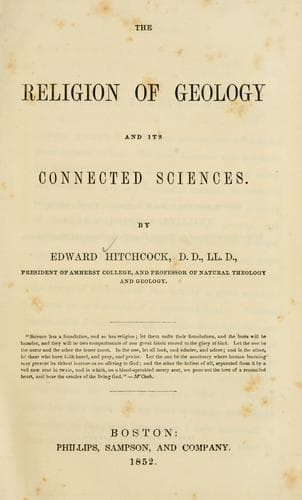
The Religion of Geology and Its Connected SciencesHitchcock, Edward
Religion
The Religion of Geology and Its Connected Sciences
Hitchcock, Edward
Bible and geology; Religion and science
In all ages of the world, where men have been enlightened enough to reason
upon the causes of phenomena, a mysterious and a mighty power has been
imputed to the laws of nature. A large portion of the most enlightened men
have felt as if those laws not only explain, but possess an inherent
potency to continue, the ordinary operations of nature. Most men of this
description, however, have thought that to originate nature must have
demanded the special exercise of an infinite and all-wise Being. But a
few, in every age, have endeavored to exalt law into a Creator, as well as
Controller, of the world. The hypothesis has assumed a great variety of
forms, and until recently few have attempted to draw it out in all its
details, and apply it to all nature. Among the ancient philosophers it was
based on the eternity of matter, and made the foundation of a system of
rank atheism. Starting with the position, as an axiom, that nothing
produces nothing,--in other words, that creation out of nothing is
impossible,--Democritus maintained that all existence was the result of
two necessary and self-existent principles, viz., space, infinite in
extent, and atoms, infinite in number. The latter have been eternally in
motion, in directions varying from right lines; and their necessary
collisions have produced the various forms of organic and inorganic
nature. To produce animals and plants, it was only necessary that the
atoms should be suitably arranged. The only animating principle was the
rapid agitation of atoms.
Public-domain text, read in full here on John Shaqi.
Reviews
Reviews
No reviews yet
Be the first to share your thoughts on this work.
Elsewhere in the archive
Join the Discussion
Join the discussion
Sign in to leave a comment or review.
Sign InorCreate an account