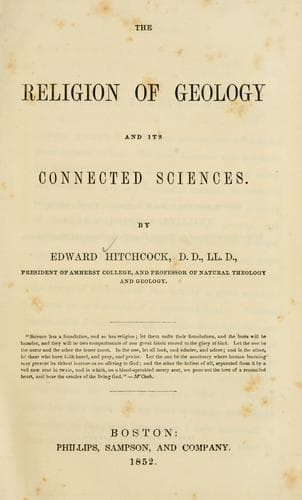
The Religion of Geology and Its Connected SciencesHitchcock, Edward
Religion
The Religion of Geology and Its Connected Sciences
Hitchcock, Edward
Bible and geology; Religion and science
He declares that his "purpose is, to show that the whole revelation of the
works of God presented to our senses and reason is a system based on what
we are compelled, for want of a better term, to call _law_; by which,
however, is not meant a system independent or exclusive of the Deity, but
one which only proposes _a certain mode of his working_."--_Sequel to the
Vestiges of Nat. Hist. of Creation_, p. 2.--But this is by no means all
that is meant by this hypothesis. Nay, the grand object of the writer
above quoted is, to show that there is no such thing as miraculous
interference in the creation or preservation of the universe. He admits
only the ordinary laws of nature, but denies all special and extraordinary
laws; and says that it does not "appear necessary that God should exercise
an immediately superintending power over the mundane economy."--_Vestiges_,
p. 273.--Nay, he denies that the original creation of the universe and of
animals and plants required any thing but the operation of natural laws;
of such laws as we see and understand. The thought does not seem to have
occurred to him, that special and miraculous acts of the Deity may be as
truly governed by law as the motions of planets. Every thing of that sort
he seems to regard as a violation of law,--a stepping aside from fixed
principles,--a sort of afterthought with Jehovah,--a remedy for some
defect in his original plans. True, the law of miracles and of special
providence is very different from the common course of nature; and,
therefore, the one may for a time supersede the others. But this does not
prove that the former is not regulated by laws; nor that it did not enter
into the original plan of the universe in the divine mind. It must have
been a part of that plan; every thing was a part of it, and there can be
with him no afterthought, no improvement, no alteration of his eternal
designs.
Admitting that every event, miraculous as well as common, is under law, it
by no means renders a present directing and energizing Deity unnecessary.
This hypothesis admits that organic life had a beginning, for its grand
object is to show how it began by law alone. Now, who gave to matter, in a
gaseous state, such wonderful laws that this fair world should be the
result of their operation? If it would require infinite wisdom as well as
power to create the present universe at once out of nothing, would it
demand less of contrivance and skill to impart such powers to brute
matter? It was not merely a power to produce organic natures, to form
their complicated organs, to give life, and instinct, and intellect; but
to adapt each particle, each organ, each animal, and each plant, most
exactly and most wonderfully to its place in the vast system, so that
every single thing should most beautifully harmonize with every other
thing.
Public-domain text, read in full here on John Shaqi.
Reviews
Reviews
No reviews yet
Be the first to share your thoughts on this work.
Elsewhere in the archive
Join the Discussion
Join the discussion
Sign in to leave a comment or review.
Sign InorCreate an account