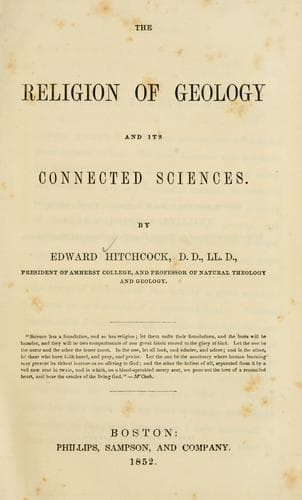
The Religion of Geology and Its Connected SciencesHitchcock, Edward
Religion
The Religion of Geology and Its Connected Sciences
Hitchcock, Edward
Bible and geology; Religion and science
a conatus for walking would form the feet and legs of quadrupeds. Thus the
organs were not formed to meet the wants, but by the wants, of the animal
and plant. Of course, new wants would produce new organs; and thus have
animals been growing more and more complicated and perfect from the
earliest periods of geological history. Man began his course as a monad,
but, by the force of Lamarck's two principles, has reached the most
elevated rank on the scale of animals. His last condition before his
present was that of the monkey tribe, especially that of the orang-outang.
The advocates of this hypothesis generally, however, suppose that there
are from three to fifteen species of men, and that the different races are
not mere varieties of one species. The most perfect species, the
Caucasian, after leaving the monkey state, has gradually risen through the
inferior species, and is still making progress; so that we cannot tell
where they will stop. In general, the advocates of this hypothesis are
materialists; that is, they do not suppose that there is a soul in man,
distinct from the body, but that thought is one of the functions of the
brain. They usually also regard moral qualities as mainly dependent upon
organization, agreeably to the opinions of ultra phrenologists; and hence
that they are more to be pitied than blamed for their deviations from
rectitude.
Such is the hypothesis. Let us now, in the first place, assume it to be
proved, and see what inferences follow.
_I remark, first, that the occurrence of events according to law does not
remove the necessity of a divine contriving, superintending, and
sustaining Power._
That every event in the universe takes place according to fixed laws I am
ready to admit. For what is a natural law? Nothing more nor less than the
uniform mode in which divine power acts. In the case of miracles, it may
be that the ordinary laws of nature are suspended or counteracted; at
least, they are increased or diminished in their power. Yet from what we
know of the divine perfections, we must conclude that God has certain
fixed rules by which he is regulated in the performance of miracles; and,
of course, in the same circumstances we should expect the same miracles.
So that we may reasonably admit that even miracles are regulated and
controlled by law, like common events; though, from the infrequency of the
former, men cannot understand the laws that regulate them.
Now, if the advocates of this hypothesis mean simply that every event is
regulated by law,--in other words, that with like antecedents like
consequents will be connected,--I have no controversy with them; and such
is the precise statement of a modern anonymous popular writer on the
subject.
Public-domain text, read in full here on John Shaqi.
Reviews
Reviews
No reviews yet
Be the first to share your thoughts on this work.
Elsewhere in the archive
Join the Discussion
Join the discussion
Sign in to leave a comment or review.
Sign InorCreate an account