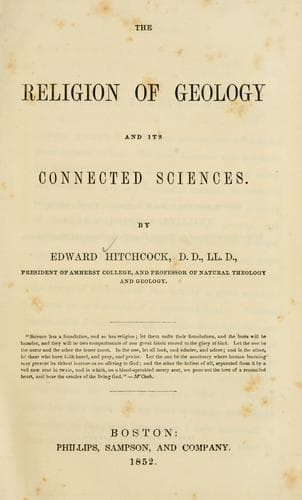
The Religion of Geology and Its Connected SciencesHitchcock, Edward
Religion
The Religion of Geology and Its Connected Sciences
Hitchcock, Edward
Bible and geology; Religion and science
I know, indeed, that La Place, and some other advocates of this latter
hypothesis, do not admit any necessity for a Deity even to originate
matter or its laws; and to prove this was the object of the nebular
hypothesis. But how evident that in this he signally failed! For even
though he could show how nebulous matter, placed in a certain position,
and having a revolution, might be separated into sun and planets, by
merely mechanical laws, yet where, save in an infinite Deity, lie the
power and the wisdom to originate that matter, and to bring it into such a
condition, that, by blind laws alone, it would produce such a universe--so
harmonious, so varied, so nicely adjusted in its parts and relations as
the one we inhabit? Especially, how does this hypothesis show in what
manner these worlds could be peopled by countless myriads of organic
natures, most exquisitely contrived, and fitted to their condition? The
atheist may say that matter is eternal. But if so, what but an infinite
mind could in time begin the work of organic creation? If the matter
existed for eternal ages without being brought into order, and into
organic structures, why did it not continue in the same state forever?
Does the atheist say, All is the result of laws inherent in matter? But
how could those laws remain dormant through all past eternity,--that is,
through a period literally infinite,--and then at length be aroused into
intense action? Besides, to impute the present wise arrangements and
organic creations of the world to law, is to endow that law with all the
attributes with which the Theist invests the Deity. Nothing short of
intelligence, and wisdom, and benevolence, and power, infinitely above
what man possesses, will account for the present world. If there is, then,
a power inherent in matter adequate to the production of such effects,
that power must be the same as the Deity; and, therefore, it is truly the
Deity, by whatever name we call it. In short, the fact that La Place did
not see that his hypothesis utterly failed to account for the universe
without a Deity, strikingly shows us, that a man may be a giant in
mathematics, while he is only a pygmy in moral reasoning; or, to make the
statement more general, how a man, by an exclusive cultivation of one
faculty of the soul, may shrivel all the rest into a nutshell.
From these views and reasonings, it is clear, I think, that the hypothesis
of creation by law does not necessarily destroy the theory of religion.
For if we admit that every thing in the world of matter and of mind, not
excepting miracles and special providences, is regulated, if not produced,
by law, it does not take away the necessity of a contriving, sustaining,
and energizing Deity. Even though we admit that God has communicated to
nature's laws, at the beginning, a power to execute themselves, (though
the supposition is quite unphilosophical,) no event is any the less God's
work, than if all were miraculous.
Public-domain text, read in full here on John Shaqi.
Reviews
Reviews
No reviews yet
Be the first to share your thoughts on this work.
Elsewhere in the archive
Join the Discussion
Join the discussion
Sign in to leave a comment or review.
Sign InorCreate an account