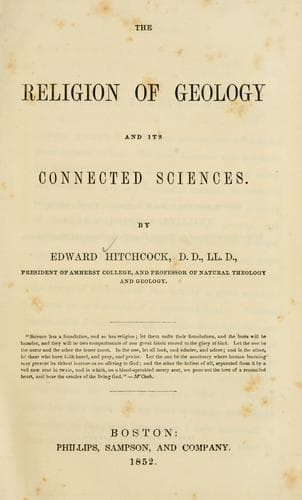
The Religion of Geology and Its Connected SciencesHitchcock, Edward
Religion
The Religion of Geology and Its Connected Sciences
Hitchcock, Edward
Bible and geology; Religion and science
In consistency with this conclusion, we find that while some advocates of
this hypothesis evidently intended it to sustain atheism, its most
plausible advocate, as we have seen, fully admits, not only the divine
existence, but the reality of revelation. It may, indeed, be doubted
whether this anonymous writer has not virtually taken away the Deity, and
even moral accountability, by his materialism and his ultra-phrenology;
yet we do not see but he may assert his law system without denying God's
existence or attributes.
It must be admitted, however, that the influence of this hypothesis upon
practical religion is disastrous. It does, apparently, so remove the Deity
from all concern in the affairs of the world, and so foists law into his
place, that practically there is no God. If his agency is acknowledged, as
having put the vast machine in motion, in some indefinitely remote period
of past duration, yet the feeling is, that since then he has given up the
reins into the hands of law, so that man has nothing to do with him, but
only with nature's laws; that he has only to submit to these, and not
expect any interposition for his relief, however earnestly he cry for it.
Now, it is obviously the intention and desire of the advocates of this
hypothesis thus to remove God away from his works, and from their
thoughts; else why should they so strenuously resist the notion of
miracles? For these may just as properly be referred to law as common
events. Yet it is one of the most striking features of the hypothesis,
that it opposes strongly the idea of any special oversight and
interposition on the part of the Deity. True, when we look at the subject
philosophically, we must acknowledge that an event is just as really the
work of God, when brought about by laws which he ordains and energizes, as
by miraculous interposition. Still the practical influence of these two
views of Providence is quite different.
Public-domain text, read in full here on John Shaqi.
Reviews
Reviews
No reviews yet
Be the first to share your thoughts on this work.
Elsewhere in the archive
Join the Discussion
Join the discussion
Sign in to leave a comment or review.
Sign InorCreate an account