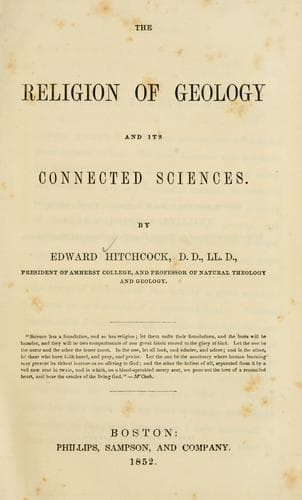
The Religion of Geology and Its Connected SciencesHitchcock, Edward
Religion
The Religion of Geology and Its Connected Sciences
Hitchcock, Edward
Bible and geology; Religion and science
Not many years since, the equivocal or casual production of animalcula,
without any other parentage than law, was thought to be made out by a
multitude of facts. For these minute creatures appeared almost every
where, and in places where it seemed impossible that their ova should be
found. But the researches of Ehrenberg have cleared up the difficulties of
their origination in the ordinary modes of reproduction, in nearly every
instance, and the advocates of the law hypothesis have been fairly driven
from this stronghold of their argument. In describing the various modes of
reproduction with which nature has provided the infusoria, Professor Owen
says, "Thus each leaves, by the last act of its life, the means of
perpetuating and diffusing its species by thousands of fertile germs. When
once the thickly tenanted pool is dried up, and its bottom converted into
a layer of dust, these inconceivably minute and light ova will be raised
with the dust by the first puff of wind, diffused through the atmosphere,
and may there remain long suspended; forming, perhaps, their share of the
particles which we see flickering in the sunbeam, ready to fall into any
collection of water, beaten down by every summer shower into the streams
or pools which receive or may be formed by such showers, and, by virtue of
their tenacity of life, ready to develop themselves whenever they may find
the requisite conditions of their existence. The possibility, or, rather,
the high probability, that such is the design of the oviparous generation
of the infusoria, and such the common mode of the diffusion of their ova,
renders the hypothesis of equivocal generation, which has been so
frequently invoked to explain their origin in new-formed natural or
artificial infusions, quite gratuitous."--_Lectures on Comp. Anat._ vol.
ii. p. 31.
No longer able to maintain a foothold among the animalcula, the defenders
of this hypothesis have of late attempted to take a stand among animals of
a somewhat higher grade, viz., the entozoa, or animals inhabiting other
animals. These being considerably larger than the infusoria, their ova
could not float in the atmosphere; but they possess a wonderful tenacity
of life; some of them exhibiting signs of life after having been in
boiling water for an hour; others have revived after having been packed
for a long time in ice, and frozen; others have revived after lying in a
dried state for six or seven years. Their power of reproduction, in the
ordinary modes, is also prodigious, exceeding even that of the infusoria.
It will, then, demand very strong evidence to prove that such animals
possess also the power of spontaneous production, without parentage, or
that their existence within other animals cannot be explained without such
a supposition. For, if capable of being produced without parentage, why
should such extraordinary care have been taken for their multiplication,
in almost all the ordinary modes in which animals are reproduced?
Public-domain text, read in full here on John Shaqi.
Reviews
Reviews
No reviews yet
Be the first to share your thoughts on this work.
Elsewhere in the archive
Join the Discussion
Join the discussion
Sign in to leave a comment or review.
Sign InorCreate an account