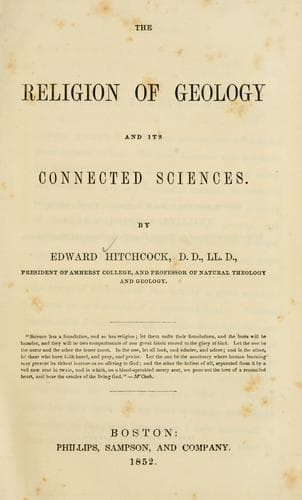
The Religion of Geology and Its Connected SciencesHitchcock, Edward
Religion
The Religion of Geology and Its Connected Sciences
Hitchcock, Edward
Bible and geology; Religion and science
The extraordinary facts that have been discovered by Professors
Steenstrup, Owen, and others, within a few years, respecting what they
call _alternate generation_, or _parthenogenesis_, have been thought
favorable to the hypothesis of development. Among the mollusca, the
polyparia, the entozoa, and infusoria, it is found that, in some species,
the result of sexual union is the production of a larva without sex, and,
therefore, incapable of propagating in the usual way. Yet that larva can
of itself produce another larva quite different from itself, and this
larva another, and so on, sometimes for eight or ten generations, when the
spermatic force seems to be exhausted, and a progeny exactly like the
original parents that started the series is produced, capable of giving
rise to another and a similar series. Here, then, we find a succession of
progeny for several generations, and all quite unlike one another, yet
without any immediate parental agency. Why is it not an example of
spontaneous generation? and why may not new species be produced in this
manner?
There are two facts prominent on this subject which afford a full answer
to such questions. One is, that these generations of larvae always begin
with the spermatozoon and the ovum of parents; the other is, that the
series always closes, if allowed to run its natural course, in individuals
with sex, exactly identical with those that started it; so that the
species always remains entire. The whole process is simply one of the
infinitely varied modes which nature employs to preserve and perfect the
species. The process never stops with any of the larvae intervening between
the fertile parents at the beginning, and the fertile individuals at the
end of the series. Professor Owen supposes--certainly with much
plausibility--that some of the original germ-cells, not wanted for the
production of the first larva, pass on to form the successive generations,
till the series is complete; so that, after all, the case is not an
exception to the general law of reproduction by parental agency; and
instead of sustaining, it certainly goes against, the notion of
spontaneous generation and of transmutation of species; because it shows
how far parental influence may reach, and how tenacious nature is of
specific distinctions. For the same reasons, the case affords a
presumption against other alleged cases of equivocal generation and
metamorphoses of species.[18]
Appeal has also been made to the vegetable kingdom for examples of the
production of organic beings, viz., plants without seeds. Who has not
observed, for instance, how the clearing up and burning over of a piece of
land will often cause an entirely new tribe of plants to spring up and
flourish? Whence came the seeds? We have seen, for instance, (in Richmond,
Virginia,) a thick growth of pines upon a spot where from six to ten feet
of soil had been removed a few years previously.
Public-domain text, read in full here on John Shaqi.
Reviews
Reviews
No reviews yet
Be the first to share your thoughts on this work.
Elsewhere in the archive
Join the Discussion
Join the discussion
Sign in to leave a comment or review.
Sign InorCreate an account