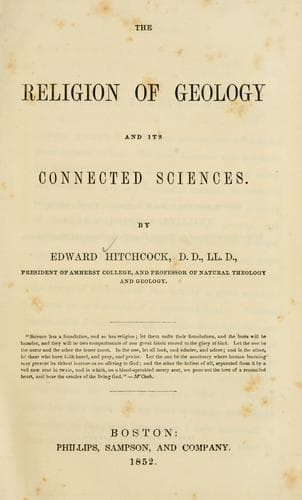
The Religion of Geology and Its Connected SciencesHitchcock, Edward
Religion
The Religion of Geology and Its Connected Sciences
Hitchcock, Edward
Bible and geology; Religion and science
Such a general view of the subject of organic remains seems to give
plausibility to the hypothesis of organic development. But the tables are
turned when we descend to particulars. The idea of a distinct stirps or
germ for each great class of animals and plants seems to me to destroy an
essential feature of the hypothesis. It supposes that law produces at once
a vertebral animal and a flowering plant; for the first, certainly, we
find in the very lowest of the fossiliferous rocks. "The lower silurian,"
says Sir Roderick Murchison, in 1847, "is no longer to be viewed as an
invertebrate period, for the onchus (a genus of fish) has been found in
the Llandeilo Flags, and in the lower silurian rocks of Bala."
It is also a most important fact, that this fish of the oldest rock was
not, as the development scheme would require, of a low organization, but
quite high on the scale of fishes. The same is true of all the earliest
species of this class. "All our most ancient fossil fishes," says
Professor Sedgwick, "belong to a high organic type; and the very oldest
species that are well determined fall naturally into an order of fishes
which Owen and Mueller place, not at the bottom, but at the top of the
whole class."--_Discourse on the Studies of the University_, &c. 5th edit.
p. lxiv. pref.
This point has been fully and ably discussed by Hugh Miller, Esq., in his
late work, "The Footprints of the Creator, or the Asterolepis of
Stromness." The asterolepis was one of these fishes found in the old red
sandstone, sometimes over twenty feet long; yet, says Mr. Miller, "instead
of being, as the development hypothesis would require, a fish low in its
organization, it seems to have ranged on the level of the highest
ichthyic-reptilian families ever called into existence."
Public-domain text, read in full here on John Shaqi.
Reviews
Reviews
No reviews yet
Be the first to share your thoughts on this work.
Elsewhere in the archive
Join the Discussion
Join the discussion
Sign in to leave a comment or review.
Sign InorCreate an account