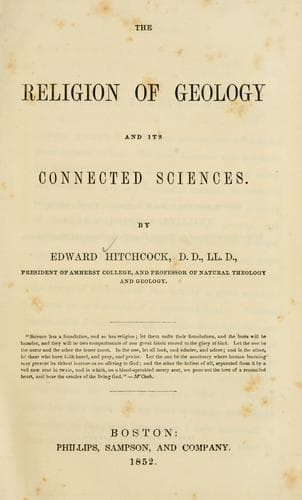
The Religion of Geology and Its Connected SciencesHitchcock, Edward
Religion
The Religion of Geology and Its Connected Sciences
Hitchcock, Edward
Bible and geology; Religion and science
The phenomena of hybridity furnish another ground of argument in favor of
the transmutation of species, and of course in favor of the law
hypothesis; for that hybrids are sometimes the result of the union of
different species will not be denied. There is, however, a natural
repugnance to union between different species; and in a state of nature
this can very rarely be overcome. But domestication changes and almost
obliterates many natural instincts, and hence hybridity is far more common
among domesticated animals and plants. As a general fact, also, the hybrid
offspring is incapable of propagating its own race, without union with one
of the original species by which it was produced; and this inability to
continue this mixed race has been generally regarded among naturalists as
the best characteristic of species. Some, however, attempt to show that
some hybrid races do continue from generation to generation to propagate
their kind. But in most cases the hybrid race ere long runs out, and there
is always a strong tendency to revert to the original stock; and were it
not for the influence of man, probably such a thing as hybridity would
scarcely ever have been heard of. Nature seems to have established strong
barriers around species, so that an identity should be preserved; and even
if we admit the possibility of their coalescence in some cases, yet we
have evidence that almost always they are preserved distinct from century
to century; and the same is true even of the more prominent varieties, for
we find not only the same species, but the same varieties of animals and
plants, preserved some three thousand years in the Egyptian catacombs,
that are now alive in the same country. How idle, then, to suppose that
the laws of hybridity will account for such radical and entire
transmutations as this hypothesis supposes! To accomplish this, it would
need as strong a tendency in nature to a union of species, genera, and
families, as now exists against it.
But a special appeal has been made on this subject to geology. The history
of organic remains, it is thought, corresponds to what we might expect, if
the hypothesis of development is true. In the oldest rocks we find chiefly
the more simple invertebrate animals, and the vertebrated tribes appear at
first in the form of fish, then of reptiles, then of birds, then of
mammals, and last of all of man. What better confirmation could we wish
than this gradually expanding series? True, all the great classes of
organic beings, vegetable and animal, are found nearly at the earliest
epoch, and continue through the entire series of rocks. But we have only
to suppose a distinct stirps for each of the classes, and that the
developments took place along parallel lines, in order to harmonize the
facts with the hypothesis.
Public-domain text, read in full here on John Shaqi.
Reviews
Reviews
No reviews yet
Be the first to share your thoughts on this work.
Elsewhere in the archive
Join the Discussion
Join the discussion
Sign in to leave a comment or review.
Sign InorCreate an account