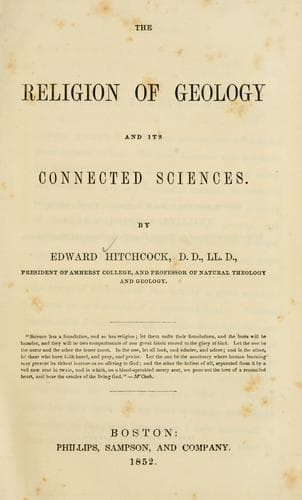
The Religion of Geology and Its Connected SciencesHitchcock, Edward
Religion
The Religion of Geology and Its Connected Sciences
Hitchcock, Edward
Bible and geology; Religion and science
There is not a more striking thing in nature than that adaptation; and
geology shows us that it has always been so. Now, if any thing requires
the exercise of infinite wisdom and power, it is this feature of creation.
But according to this hypothesis, the laws of nature may be so arranged as
to create every animal and plant just at the right time, and place them in
the right spot, and adjust every thing around them to their nature and
wants. In other words, it supposes law capable of doing what only infinite
wisdom and power can do. What is this but ascribing infinite perfection to
law, and imputing to it effects which only an infinite intelligence could
bring about? In other words, it is making a Deity of the laws which he
ordains. Theoretically it may be of little importance by what name men
call the Deity; but practically to impute natural effects to law, as an
independent power, is to put a blind, unintelligent agency in the place of
Jehovah.
_In the second place, where one fact in nature looks favorable to this
hypothesis, a thousand facts teach the contrary._
Take for example the reproduction of animals. Out of every thousand
individuals we have certain evidence that nine hundred and ninety-nine are
brought into existence by the ordinary modes of generation; that is, they
depend upon progenitors. Still, if in the thousandth case the animal's
existence was clearly casual, if we could see an elephant, or an ox, start
into life without parental agency, that single case would prove the
hypothesis. But never do its advocates pretend that any of the larger
animals are produced in this way. Nor is it till they get among the
smaller and obscure animals, whose habits are very difficult to trace out,
that we find any examples where a suspicion even can exist of the
communication of vitality irrespective of parental agency. Is not a strong
presumption hence produced that further and more scrutinizing observation
will show the few excepted cases not to be real exceptions? Does not sound
philosophy demand that the proof of the casual production of the
thousandth case shall be as decided as that of the normal generation of
the nine hundred and ninety-nine? But no one, it seems to me, will pretend
that any thing like such certainty exists in a single example throughout
all nature. The presumption, then, is really more than a thousand to one
against the hypothesis.
Public-domain text, read in full here on John Shaqi.
Reviews
Reviews
No reviews yet
Be the first to share your thoughts on this work.
Elsewhere in the archive
Join the Discussion
Join the discussion
Sign in to leave a comment or review.
Sign InorCreate an account