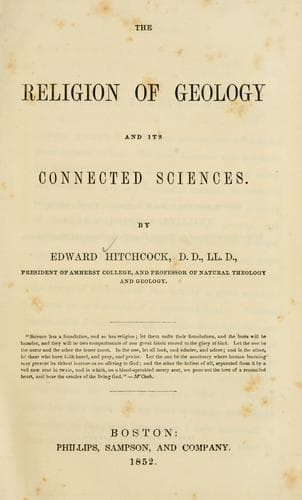
The Religion of Geology and Its Connected SciencesHitchcock, Edward
Religion
The Religion of Geology and Its Connected Sciences
Hitchcock, Edward
Bible and geology; Religion and science
Take an example from hybridity. While a thousand species retain from age
to age their individuality, not more than one coalesces with its neighbor,
and loses its identity. And even here, all admit that there is a constant
tendency in the hybrid race to revert to the original stock; and there is
strong reason to believe that this will sooner or later take place, and
that it would speedily occur in every case, were it not for the influence
of domestication. Such facts make the presumption very strong, that
species are permanent, and any extensive metamorphosis impossible.
Hybridity appears to be in a measure unnatural; and the old proverb true
in respect to it--
"Si furca naturam expellas,
Usque recurret."
By the hypothesis under consideration, we ought to expect at least a few
examples of the formation of new organs in animals, in the efforts of
nature to advance towards a more perfect state. It has usually been said
that the time since animals were first described is too short for such
development. But we have examples, from the catacombs of Egypt, of animals
and plants that lived in that country three thousand years ago; and yet,
according to Cuvier,--and who is a better judge?--they are precisely like
the living species. Strange that this great length of time should not have
produced even one new organ, or the marks of a conatus to produce one. We
are, indeed, pointed to the different varieties of the human species, as
examples of this progress. But these diversities, also, can be shown to be
the same now as at the earliest date of historical records; and where,
then, is the evidence that they ever have undergone, or ever will undergo,
any change of importance? There may indeed be examples of amalgamation,
but under favorable circumstances the original varieties are again
developed.
_In the third place, geology contradicts this hypothesis._
We have seen that it offers no satisfactory explanation of the gradual
increase of the more perfect animals and plants, as we rise higher in the
rocks. That fact is most perfectly explained by supposing that divine
wisdom and benevolence adapted the new species, which from time to time
were created, to the changing and improving condition of the earth. A
multitude of species have been dug from the rocks; but not one exhibits
evidence of the development of new organs in the manner described by this
hypothesis. New species often appear, but they differ as decidedly from
the previous ones as species now do; and at the beginning of each
formation there is often a very decided advance in the organic beings from
those found in the top of the subjacent formation. How can this hypothesis
explain such sudden changes, when its essential principle is, that the
progress of the development is uniform? Nothing can explain them surely
but special creating interposition.
Public-domain text, read in full here on John Shaqi.
Reviews
Reviews
No reviews yet
Be the first to share your thoughts on this work.
Elsewhere in the archive
Join the Discussion
Join the discussion
Sign in to leave a comment or review.
Sign InorCreate an account