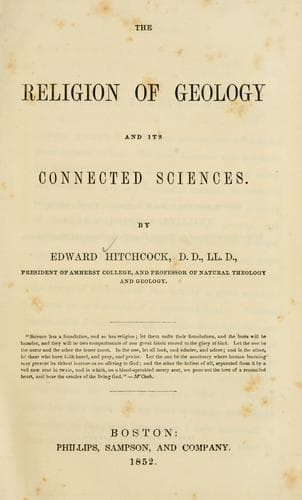
The Religion of Geology and Its Connected SciencesHitchcock, Edward
Religion
The Religion of Geology and Its Connected Sciences
Hitchcock, Edward
Bible and geology; Religion and science
_In the fifth place, it is an instructive fact on this subject that, as
instruments have been improved, and observations have become more
searching, the supposed cases of spontaneous generation have diminished_,
until it is not pretended now that it takes place except in a very few
tribes, and those the most obscure and difficult to observe of all living
things. A hundred years ago, naturalists, and especially other men, might
easily have been made to believe that many of the smaller insects had a
casual origin. But long since, save in the matter of the acari, the
entomological field has been abandoned by the advocates of the law
hypothesis, and they have been driven from one tribe after another, till
at length some of the obscure hiding-places of the entozoa and infusoria
are now the only spots where the light is not too strong for the
large-pupiled eyes of this hypothesis. Is not the presumption hence
arising very strong that it will need only a little further improvement in
instruments and care in observation to carry daylight into these recesses,
and demonstrate the parentage and normal development of all organic
beings?
_Finally. The gross materialism inseparable from this hypothesis is a
strong argument against it._
I am not aware that any one, except Oken, perhaps, has ever attempted to
show that mind, as a spiritual essence, distinct from matter, has been
created by natural laws; in other words, that there is in nature a power
to produce mind. All such maintain that intellect is material, or, rather,
the result of organization, the mere function of the brain, as are also
life and instinct. Generally, also, they contend--and, indeed, consistency
seems to require it--that the moral powers depend chiefly upon different
developments of the brain; so that a disposition to do wrong results more
from organization than from punishable mental obliquity; indeed, the worst
of criminals are often, on this account, more to be pitied than blamed,
and the physician is of more importance than the moralist and the divine
for their reformation.
Now, if this system of materialism is true, we ought to embrace it,
without any fear of ultimate bad effects. But a philosopher will hesitate
long before he adopts a system which thus seems to degrade man from his
lofty standing as a spiritual, accountable, and immortal being, and makes
his intellectual and moral powers dependent upon the structure of the
brain, and, therefore, destined to perish with the material organization,
with no hope of future existence, unless God chooses to recreate the man.
Nay, if there be no distinct spirit in man, what evidence have we that
there is one in Jehovah? A true philosopher, I say, will demand very
strong evidence before he adopts any hypothesis that leads a logical mind
to such conclusions; and I see not how the one under consideration can
terminate in any thing else.
Public-domain text, read in full here on John Shaqi.
Reviews
Reviews
No reviews yet
Be the first to share your thoughts on this work.
Elsewhere in the archive
Join the Discussion
Join the discussion
Sign in to leave a comment or review.
Sign InorCreate an account