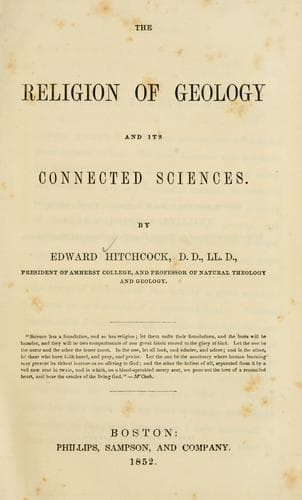
The Religion of Geology and Its Connected SciencesHitchcock, Edward
Religion
The Religion of Geology and Its Connected Sciences
Hitchcock, Edward
Bible and geology; Religion and science
Geology also shows us that for a vast period the world existed without
inhabitants. Now, what was it that gave the laws of nature power, after so
long an operation unproductive of vitality, to produce organic natures?
Who can conceive of any inherent force that should thus enable them, all
at once, to do what true philosophy shows to have demanded infinite
skill?
In short, of all the sciences, geology most clearly shows special divine
interference to explain its phenomena. It presents us with such stupendous
changes, after long periods of repose, such sudden exhibitions of life,
springing forth from the bosom of universal death, that nothing but
divine, special, miraculous agency can explain the results. And of all the
vast domains of nature, it seems to me no part is so barren of facts to
sustain this hypothesis as the rocks; nor so full of facts for its
refutation. These, however, have been so fully detailed in a previous part
of this lecture that they need not be here repeated.
_In the fourth place, the prodigious increase of the power and the means
of reproduction, which we find among the lower tribes of animals, affords
a strong presumption against this hypothesis._
The animals highest on the scale, and most perfect in their organization,
have only one mode of reproduction, viz., the viviparous. Descending a
little lower, we come to the oviparous and ovoviviparous tribes. Passing
to the invertebrate animals, we meet with two other modes of reproduction,
the gemmiparous and fissiparous. In the first mode, the animal is
propagated by buds, like some plants, as the tiger lily; by the second
mode, a spontaneous division of the animal takes place.
Now, in some of the lowest of the invertebrate tribes, we find most of the
modes of propagation that have been enumerated in operation; so that the
same individual in one set of circumstances is oviparous, in another
gemmiparous or fissiparous. The consequence is, a power of multiplication
inconceivably great. Mr. Owen calculates that the _ascaris lumbricoides_,
the most common intestinal worm, is capable of producing sixty-four
millions of young; and Ehrenberg asserts that the _hydatina senta_, one of
the infusoria, increased in twelve days to sixteen millions, and another
species, in four days, to one hundred and seventy billions.
Why, now, are these astonishing powers of reproduction given to these
minute animals, if it be true that they can also be produced without
parentage, and by mere law? This latter mode would supersede the necessity
of the former; and therefore, the care taken by Providence to provide the
former is a strong presumption that the latter does not exist.
Public-domain text, read in full here on John Shaqi.
Reviews
Reviews
No reviews yet
Be the first to share your thoughts on this work.
Elsewhere in the archive
Join the Discussion
Join the discussion
Sign in to leave a comment or review.
Sign InorCreate an account