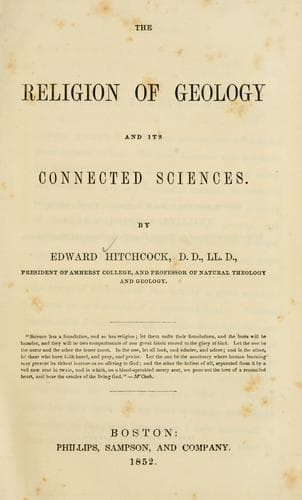
The Religion of Geology and Its Connected SciencesHitchcock, Edward
Religion
The Religion of Geology and Its Connected Sciences
Hitchcock, Edward
Bible and geology; Religion and science
glorified humanity abruptly connected, without the introduction of an
intermediate creation of _responsible_ imperfection with that of the
dying, irresponsible brute. That scene of things in which God became man,
and suffered, _seems_, as it no doubt _is_, a necessary link in the
chain."
A single concluding thought forces itself upon my mind. It is this: How
ingenious and persevering men are in deluding themselves on the subject of
religion! Since the time of Christ, what countless devices have they
framed to escape from the lofty truths and spiritual piety of his gospel!
Nor are they satisfied with this; for the gospel has shed so much light
upon the religion of nature, that even this is more than men like; and,
therefore, every science is ransacked for facts to neutralize all
religion. Men's consciences do not permit them to throw off all the forms
of religion; and, therefore, they are satisfied if they can only tear out
its heart. They like to preserve and to embalm its external covering, as
the naturalist does the skin of an animal for his cabinet. And as the
latter fills his specimen with straw and arsenic, and fits glass eyes into
it, so do men fill up their religious specimen with error and vain
speculation, and fit into its head the eyes of false philosophy, and then
claim for it intellectual worship. It is the business of educated men to
show that such caricatures are neither science nor religion. May you,
gentlemen, have your full share in this most useful and noble work.[19]
LECTURE X.
SPECIAL AND MIRACULOUS PROVIDENCE.
Next in importance to the question whether the Deity exists, is the
inquiry whether he exerts any direct agency in upholding the universe and
in controlling its events. This point has been discussed in all ages in
which there have been philosophers or theologians, and the current of
opinion has fallen principally into three channels.
In the first place, some have removed the Deity entirely from his works
into a fancied extra-mundane sphere, where in solitude he might enjoy the
blessedness of his own infinite nature, without the trouble of directing
the events of the universe, or watching over the works of his hand.
Forgetful of the great principle, that the intellectual powers produce
happiness only when called into exercise, they have fancied that the care
of the universe must be a burden to its Creator, and that it would
derogate from his dignity. It is supposed, therefore, that the world has
been given up to the rule of fate or chance.
Public-domain text, read in full here on John Shaqi.
Reviews
Reviews
No reviews yet
Be the first to share your thoughts on this work.
Elsewhere in the archive
Join the Discussion
Join the discussion
Sign in to leave a comment or review.
Sign InorCreate an account