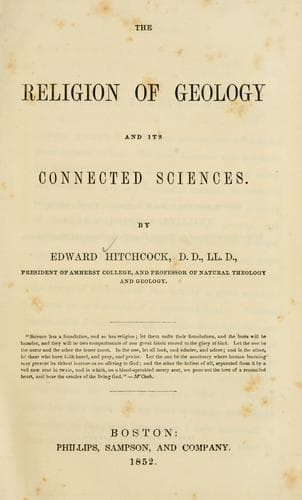
The Religion of Geology and Its Connected SciencesHitchcock, Edward
Religion
The Religion of Geology and Its Connected Sciences
Hitchcock, Edward
Bible and geology; Religion and science
In the second place, a more numerous class have maintained that the
Supreme Being, after creating the world, committed its preservation and
government either to a subordinate agent, or to the laws which he
impressed upon matter and mind, which possess an inherent power to execute
themselves; so that, in fact, God exercises no direct and immediate agency
in natural operations. The learned and usually profound Cudworth adopted
the hypothesis of a _plastic nature_, as he terms it, by which he means a
vital, spiritual, and unintelligent, yet subordinate agent, by whose
agency the world is governed and its operations carried on. At first view,
this hypothesis would seem to lead inevitably to atheism; but such was not
the intention of its author. Still, it is obviously so clumsy, that had it
not been the product of a great mind, it never would have received so much
notice, or called forth such mighty efforts for its refutation, as have
been bestowed upon it.
Two varieties of opinion exist among those who believe the world governed
and sustained by natural laws, established by the Deity. Some maintain
that these laws are general, not particular; not extending to minor
events, but only the more important; not providing for species, but only
for families. Hence they suppose that these general cases may interfere
with one another, and produce results apparently repugnant to the
intention of their Author. Others, shocked at the absurdity of such
conclusions, believe the laws of nature to extend to every event, and
never to interfere with one another, and always to act in accordance with
the divine will and appointment, but without any direct agency exerted by
the Deity. They suppose these laws--in other words, secondary agencies--to
have the power of producing all natural phenomena.
In the third place, there are others who believe that a law can have no
efficiency without the presence and agency of the lawgiver. They,
therefore, suppose every event in the natural world to be the result of
the direct and immediate agency of God. What we call laws are only the
uniform mode of his operation. They agree with the advocates of the
last-named theory in supposing the laws of nature to extend to every
event, and to be in accordance with the ordination of the Deity; but they
differ in maintaining that the presence and direct efficiency of a
lawgiver are essential to the operation of natural laws.
I should then define a Special Providence to be an event brought about
apparently by natural laws, yet, in fact, the result of a special agency,
on the part of the Deity, to meet a particular exigency, either by an
original arrangement of natural laws, or by a modification of second
causes, out of sight at the time.
Public-domain text, read in full here on John Shaqi.
Reviews
Reviews
No reviews yet
Be the first to share your thoughts on this work.
Elsewhere in the archive
Join the Discussion
Join the discussion
Sign in to leave a comment or review.
Sign InorCreate an account