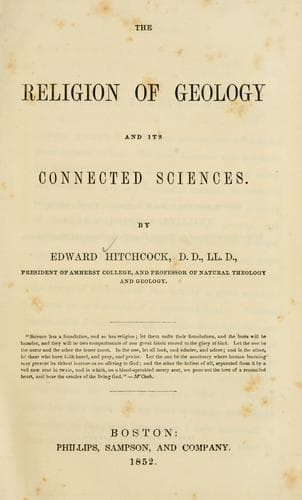
The Religion of Geology and Its Connected SciencesHitchcock, Edward
Religion
The Religion of Geology and Its Connected Sciences
Hitchcock, Edward
Bible and geology; Religion and science
"Jonathan Edwards," says M'Cosh in his Method of the Divine Government,
"somewhere illustrates the manner in which God upholds the universe, by
the way in which an image is upheld in a mirror. That image is maintained
by a continual flow of rays of light, each succeeding pencil of which
does not differ from that by which the image was first produced. He
conceives that the universe is, in every part of it, supported in a
similar way by a continual succession of acts of the divine will, and
these not differing from that which at first caused the world to spring
into existence. Now, it may be safely said of this theory that it cannot
be disproved. Several considerations may be urged in support of it."
Which of the views respecting divine providence that have been stated has
the best practical tendency, seems hardly to admit of doubt. If we believe
that God has submitted the direction and government of this world to a
subordinate agent, a plastic nature; or if we suppose he has impressed
matter and mind with certain general laws, which have the power of
executing themselves without his agency, and especially if in their
operation they do sometimes actually clash with one another, or even if
those laws extend to every movement of matter and mind,--still, if they do
not require divine efficiency, men cannot but feel that God is removed
from his works, and that the laws of nature, and not his agency, are their
security. But if they believe that every movement of matter or mind
requires a direct exercise of divine power or efficiency, just as much as
if every event was a miracle, it cannot but bring God near to us, and make
us realize his presence.
If we obtain a timepiece from London or Paris, which contains all the
springs and wheels requisite to keep it in operation, by occasionally
winding it up, how little do we think of the artist who constructed it,
except, perhaps, occasionally to admire his ingenuity! But if it had been
necessary for that artist to accompany the chronometer, and actually to
put forth the strength of his own arm every moment to keep it in motion,
how much more should we think of him and realize his presence! The same
effect, in a greater or less degree, will attend the belief that God must
be not only virtually, but substantially, present every where, and be
constantly exercising his power to keep in operation the vast machine of
the universe. It cannot but deeply impress the heart, and exert a most
salutary influence upon the affections, to realize that every event around
us is brought about by the immediate agency of the supreme Being.
Public-domain text, read in full here on John Shaqi.
Reviews
Reviews
No reviews yet
Be the first to share your thoughts on this work.
Elsewhere in the archive
Join the Discussion
Join the discussion
Sign in to leave a comment or review.
Sign InorCreate an account