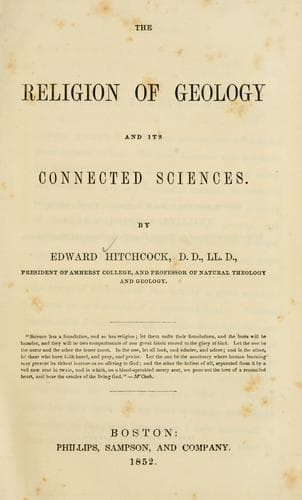
The Religion of Geology and Its Connected SciencesHitchcock, Edward
Religion
The Religion of Geology and Its Connected Sciences
Hitchcock, Edward
Bible and geology; Religion and science
In speaking of the principle of vegetable life, Sir James Edward Smith,
the eminent botanist, says, "I humbly conceive that, if the human
understanding can in any case flatter itself with obtaining, in the
natural world, a glimpse of the _immediate agency_ of the Deity, it is in
the contemplation of this _vital principle_, which seems independent of
material organization, and an impulse, of his own divine
energy."--_Introduction to Botany_, p. 26, (Boston edition.)
"We would no way be understood," says Sir John Herschel, "to deny the
constant exercise of this [God's] direct power in maintaining the system
of nature, or the ultimate emanation of every energy, which material
agents exert, from his immediate will, acting in conformity with his own
laws."--_Discourse on Nat. Philosophy._
"A law," says Professor Whewell, "supposes an agent and a power; for it is
the mode according to which the agent proceeds, the order according to
which the power acts. Without the presence of such an agent, of such a
power, conscious of the relations on which the law depends, producing the
effects which the law prescribes, the law can have no efficiency, no
existence. Hence we infer that the intelligence by which the law is
ordained, the power by which it is put in action, must be present at all
times and in all places where the effects of the law occur; that thus the
knowledge and the agency of the divine Being pervades every portion of the
universe, producing all action and passion, all permanence and change. The
laws of nature are the laws which He, in his wisdom, prescribes to his own
acts; his universal presence is the necessary condition of any course of
events; his universal agency the only origin of any efficient
force."--_Bridgewater Treatise_, p. 270.
"The student in natural philosophy," observes the Bishop of London, "will
find rest from all those perplexities, which are occasioned by the
obscurity of causation, in the proposition which, although it was
discredited by the patronage of Malebranche and the Cartesians, has been
adopted by Clarke and Dugald Stewart, and which is by far the most simple
and sublime account of the matter--that all events which are continually
taking place in the different parts of the material universe are the
_immediate_ effects of the divine agency."--_Whewell's Bridgewater
Treatise_, p. 273.
Public-domain text, read in full here on John Shaqi.
Reviews
Reviews
No reviews yet
Be the first to share your thoughts on this work.
Elsewhere in the archive
Join the Discussion
Join the discussion
Sign in to leave a comment or review.
Sign InorCreate an account