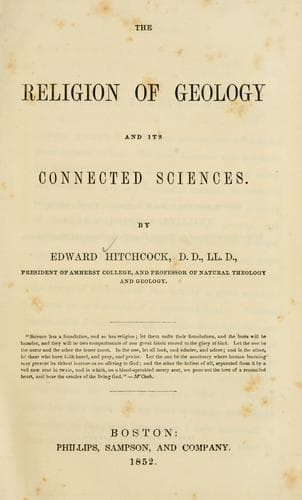
The Religion of Geology and Its Connected SciencesHitchcock, Edward
Religion
The Religion of Geology and Its Connected Sciences
Hitchcock, Edward
Bible and geology; Religion and science
The unvarying constancy of nature, in consequence of being governed by
fixed laws, is the grand argument which they adduce in opposition to any
supposed special providence. _Since the fathers fell asleep_, say they,
_all things continue as they were from the beginning._ God has subjected
the world to the government of laws, and he will not interfere with,
counteract, set aside, or give a supernatural force to those laws, to meet
particular exigencies. For the adjustment of all apparent inequalities of
good and evil, suffering and enjoyment here, we must wait for the
disclosure of eternity, when strict retributive Justice will hold her even
scales. When natural evils come upon us, therefore, it is idle to expect
their removal, except so far as they may be mitigated or overcome by
natural means; and hence it is useless to pray for their removal, or to
expect God will deliver us from them in any other way. When the heavens
over us become brass, and the earth under our feet iron, and the rain of
our land is powder and dust, and want, and famine, as the consequence,
stalk forth among the inhabitants, of what use to pray to God for rain,
since to give it would require a miracle, and the age of miracles has
passed? When the pestilence is scouring through the land, and our
neighbors and nearest friends are within its grasp, and we may next become
its victims,--nay, when we, too, are on the borders of the grave,--why
should we expect relief by prayer, since sickness is the result of natural
causes, and God will not interpose to save us from the effects of natural
evils, because that would be contrary to a fixed rule of his government?
When dangers cluster around the good man in the discharge of trying
duties, it would be enthusiasm in him to expect any special protection
against his enemies, though he pray ever so fervently, and trust in divine
deliverance with ever so much confidence. He must look to another world
for his reward, if called to suffer here. Nor has the daringly wicked man
any reason to fear that God will punish his violations of the divine law
by any unusual display of his power; not in any way, indeed, but by the
evils which naturally flow from a wicked life. In short, it will be
useless to pray for any blessing that requires the least interference with
natural laws, or for the removal of any evil which depends upon those
laws. And since our minds are controlled as much by laws as the functions
of our bodies, we are not to expect any blessings in our souls, which
require the least infringement of intellectual laws. In fine, the effect
of prayer is limited almost entirely to its influence upon our own hearts,
in preparing them to receive with a proper spirit natural blessings, and
to bear aright natural evils; to stimulate us to use with more diligence
the means of avoiding or removing the latter, and securing the former.
Public-domain text, read in full here on John Shaqi.
Reviews
Reviews
No reviews yet
Be the first to share your thoughts on this work.
Elsewhere in the archive
Join the Discussion
Join the discussion
Sign in to leave a comment or review.
Sign InorCreate an account