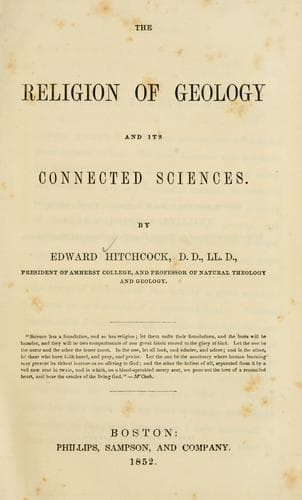
The Religion of Geology and Its Connected SciencesHitchcock, Edward
Religion
The Religion of Geology and Its Connected Sciences
Hitchcock, Edward
Bible and geology; Religion and science
Not a few philosophers of distinction, and some theologians, have adopted
these views. Even Dr. Thomas Brown uses the following language: "It is
quite evident that even Omnipotence, which cannot do what is
contradictory, cannot combine both advantages--the advantage of regular
order in the sequences of nature, and the advantages of a uniform
adaptation of the particular circumstances of the individual. We may take
our choice, but we cannot think of a combination of both; and if, as is
very obvious, the greater advantage be that of uniformity of operation, we
must not complain of the evils to which that very uniformity which we
cannot fail to prefer--if the option had been allowed us--has been the
very circumstance that gave rise."--_Lecture 94._
"Science," says George Combe, "has banished from the minds of profound
thinkers belief in the exercise by the Deity, in our day, of special acts
of supernatural power, as a means of influencing human affairs; and it has
presented a systematic order of nature, which man may study, comprehend,
and follow, as a guide to his practical conduct. Many educated laymen, and
also a number of the clergy, have declined to recognize fasts,
humiliations, and prayers, as means adapted, according to their views, to
avert the recurrence of the evil, [the potato blight.] Indeed, these
observances, inasmuch as they mislead the public mind with respect to its
causes, are regarded by such persons as positive evils."
"The most irreligious of all religious notions, as it seems to us," says
the North American Review, "is a belief in special providences; for if the
doctrine has any weight at all, it is gained at the expense of a general
providence. To assume to detect God as nearer to us on some occasions is
to put him farther off from us on other occasions. To have him in special
incidents is to forget him in the common tenor of events. The doctrine of
special providences evidently has no other foundation than this, that men
_think they can detect_ God's purpose and presence more signally in some
incidents than in others; so that the doctrine, after all, is only a
compliment to man's power of detection, instead of an acknowledgment of
God's special presence."
Such views and reasonings seem, upon a superficial examination, to be very
plausible. But when we look into the Bible, we cannot but see that the
main drift of it is directly opposed to such notions. That book does
encourage man to pray to God for the removal of evils of every kind; evils
as much dependent upon natural laws as the daily course of the sun through
the heavens. It does teach us to look to God in every trying situation for
deliverance, if it is best for us to be delivered. It does represent the
wicked man as in danger of special punishment. It exhibits a multitude of
examples, in which God has thus delivered those who trusted in him, and
punished those who violated his laws.
Public-domain text, read in full here on John Shaqi.
Reviews
Reviews
No reviews yet
Be the first to share your thoughts on this work.
Elsewhere in the archive
Join the Discussion
Join the discussion
Sign in to leave a comment or review.
Sign InorCreate an account