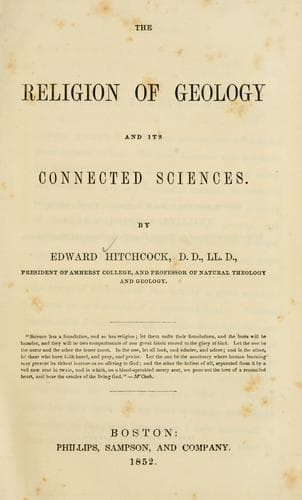
The Religion of Geology and Its Connected SciencesHitchcock, Edward
Religion
The Religion of Geology and Its Connected Sciences
Hitchcock, Edward
Bible and geology; Religion and science
But does not this principle of special adaptation to individual exigencies
demand miraculous agency in all cases? Can the wants of individuals be met
in any other way than by miracles, or by the ordinary and settled laws of
nature? I maintain that there are other modes in which this can be done;
in which, in fact, every case requiring special interference can be met
exactly and fully.
_This can be done, in the first place, by a divine influence exerted upon
the human mind, unperceived by the individual._
If it were perceived, it would constitute a miracle. But can we doubt that
the Author of mind should be able to influence it directly and indirectly,
unperceived by the man so acted upon? Even man can do this to his fellow;
and shall such a power be denied to God?
Now, in many cases,--I do not say all,--it only needs that the minds of
others should be inclined to do so and so towards a man, in order to place
him in circumstances most unlike those that would have surrounded him
without such an influence. Even the very elements, being to some extent
under human control, can thus be made subservient, or adverse, to an
individual; and, indeed, by a change in the feelings and conduct of others
towards us, by an unseen influence upon their minds, our whole outward
condition may be changed. In this way, therefore, can God, in many
instances, confer blessings on the virtuous, or execute punishment upon
the wicked, or give special answers to special prayer; and yet there
shall be no miracle about it, nor even the slightest violation of a law of
matter or of mind. The result may seem to us only the natural effect of
those laws, and yet the divine influence may have modified the effect to
any extent.
_In the second place, God can so modify the second causes of events out of
our sight, as to change wholly, or in part, the final result, and yet not
disturb the usual order of nature within sight, so that there shall be no
miracle._
A miracle requires that the usual order of nature, as man sees it, be
interrupted, or some force superadded to her agency. But if such change
take place out of our sight, it might not disturb that order within sight;
and, therefore, to us it would be no miracle.
Public-domain text, read in full here on John Shaqi.
Reviews
Reviews
No reviews yet
Be the first to share your thoughts on this work.
Elsewhere in the archive
Join the Discussion
Join the discussion
Sign in to leave a comment or review.
Sign InorCreate an account