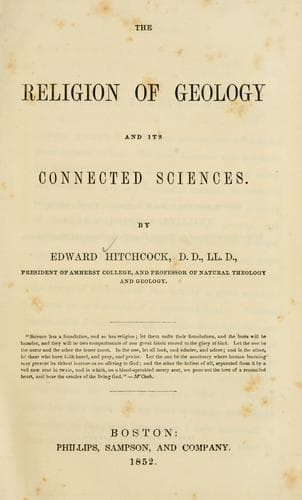
The Religion of Geology and Its Connected SciencesHitchcock, Edward
Religion
The Religion of Geology and Its Connected Sciences
Hitchcock, Edward
Bible and geology; Religion and science
In every age, too, the most devotedly pious men have testified, that they
have found deliverance and support in circumstances in which mere natural
laws could afford them no relief. Moreover, when men are brought into
great peril or suffering of any kind, they involuntarily cry to God for
help. When the vessel founders in the fury of the storm, the hardened
sailor employs that breath in ardent prayer which just before had been
poured out in blasphemies. And when the widowed mother hears the tempest
howling around her dwelling at night, she cannot but pray for the
protection of her child upon the treacherous sea. When violent disease
racks the frame, and we feel ourselves rapidly sinking into the grave, it
is scarcely in human nature to omit crying to God with a feeling that he
can save us. In short, it is a dictate of nature to call upon God in times
of trouble. Our reasoning about the constancy of nature, which appears to
us while in safety so clearly to show prayer for the removal of natural
evils to be useless, loses its power, and the feelings of the heart
triumph. It now becomes, therefore, an important practical question, which
of these views of the providence of God is correct. Is it those which our
reasoning derives from the constancy of nature, or those inspired by piety
and the Bible? I have already said, that the subject of this lecture
removes all presumption against the latter view; and I now proceed to show
how God can exercise a special providence over the world, so as to meet
the case of every individual, whether for blessing or punishment, and
that, too, without miracles.
Whoever believes that geology discloses stupendous miracles of creation,
at various epochs, will not doubt that all presumption against miraculous
agency at any other time is thus removed. For we are thus shown that the
law of miracles forms a part of the divine plan in the government of the
world. But this does not prove the same to be the fact in respect to a law
of special providence.
It is indeed true that geology gives us no distinct examples of special
providence, in the sense which we have attached to that term in the
present lecture. But it does furnish a multitude of instances in which
changes of physical condition in the earth were met by most wisely adapted
changes of organic nature. And even though these changes were the result
of miraculous agency, they disclose this principle of the divine
government, viz., that peculiarities of condition are to be met by special
arrangements, so that every exigency shall be provided for in the manner
infinite wisdom sees to be best. Now, this principle constitutes the
essence of special providence; and, therefore, geology, in showing its
past operation in the world's early organic history, affords a presumption
that the same unchanging God may still employ it in his natural and moral
government.
Public-domain text, read in full here on John Shaqi.
Reviews
Reviews
No reviews yet
Be the first to share your thoughts on this work.
Elsewhere in the archive
Join the Discussion
Join the discussion
Sign in to leave a comment or review.
Sign InorCreate an account