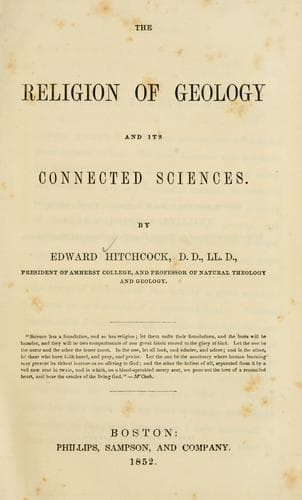
The Religion of Geology and Its Connected SciencesHitchcock, Edward
Religion
The Religion of Geology and Its Connected Sciences
Hitchcock, Edward
Bible and geology; Religion and science
To illustrate this principle, let us imagine a few examples. Suppose the
land visited by drought, and its pious inhabitants assemble to pray for
rain. We know very well that the causes on which a storm of rain depend
are very complicated. How easy for the divine Being, in answer to those
prayers, to modify one or more of these secret agencies of meteorological
change, that are concealed from our sight, so as to bring together the
vapors over the land and condense them into rain! And yet that storm shall
have nothing about it unusual, and it results from the same laws which we
have before seen to be in operation. Still, it may have been the result of
a special agency exerted by Jehovah in answer to prayer, yet in such a
manner that no known law of nature is infringed upon, or even rendered
more powerful in its action.
Equally intricate and complicated are the causes of disease, and
especially of those pestilences that sometimes march over a whole
continent, with the angel of death in their train; and alike easy is it
for God, in answer to earnest prayer, to avert their progress, or to
cripple their power, or turn them aside from a particular district,
without the least interference with the visible connection of cause and
effect.
The beloved father of a family lies upon a bed of sickness, and disease is
fast gaining upon the powers of life. His numerous and desolate family, in
spite of the cold suggestion that it will be of no avail, will earnestly
beseech the Being in whose hands is the power of disease, to arrest the
fatal malady. And could not their Father in heaven, in the way I have
pointed out, give them their request, and yet their parent's recovery be
the natural result of careful nursing and medical skill? imposing,
however, upon that family as great an obligation as if a manifest miracle
had been wrought to save him.
The widow's only son, in spite of her counsels and entreaties, becomes a
vagabond upon the seas, and, at length, one of the crew of the battle
ship. The perils of the deep and of vicious companions are enough to make
that widow a daily and most earnest suppliant at the mercy-seat of her
heavenly Father, for his protection and salvation. But, at length, war
breaks out, and the perils of battle render his fate more doubtful. Still,
faith in God buoys up her heart, and she cannot abandon the hope of yet
seeing her son returned, reformed, and becoming a useful man. And at
length, rescued from the storm and shipwreck, and the carnage of battle,
and the yet more dangerous snares of sin, that youth returns, a renovated
man, and cheers that mother's setting sun by an eminently useful life.
Now, all this may have happened simply by the operation of natural laws.
But it may also have been the result of divine interference in answer to
prayer; and hard will you find it to convince that rejoicing mother that
the hand of God's extraordinary providence was not in it.
Public-domain text, read in full here on John Shaqi.
Reviews
Reviews
No reviews yet
Be the first to share your thoughts on this work.
Elsewhere in the archive
Join the Discussion
Join the discussion
Sign in to leave a comment or review.
Sign InorCreate an account