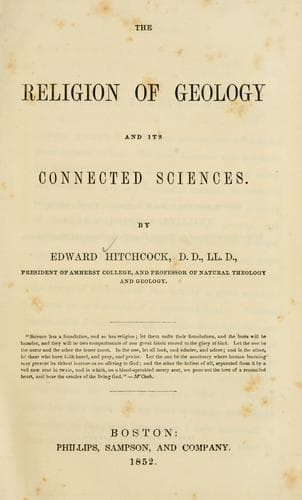
The Religion of Geology and Its Connected SciencesHitchcock, Edward
Religion
The Religion of Geology and Its Connected Sciences
Hitchcock, Edward
Bible and geology; Religion and science
The devoted missionary, at the promptings of a voice within, quits a land
of safety and peace, and finds himself in the midst of dangers and
sufferings of almost every name; _in perils of waters, in perils of
robbers, in perils in the city, in perils in the wilderness, in weariness,
in watchings often, in hunger and thirst, in fastings often, in cold and
nakedness_. The furnace of persecution is heated, and he performs his
duties with his life constantly in his hand. But he uses no weapon save
faith and prayer. He feels that "he is immortal till his work is done."
And, in fact, he outlives all his dangers, and, in venerable old age,
surrounded by the fruits of his labor,--a reformed and affectionate
people,--he passes quietly into the abodes of the blessed. Here, again,
why should we hesitate to refer his protection and deliverance to the
special interposition of his heavenly Father, in the manner I have pointed
out?
On the other hand, the history of dreadfully wicked men is full of
terrible examples of calamity and suffering, as the consequence of their
sins. True, the evil came upon them apparently by the operation of natural
laws; but shall we hence infer that God in no case has so modified these
laws, by an agency among the hidden causes of events, as to make the
result certain? He certainly could do this; and to say that he never has
done it, is to remove one of the most powerful restraints that operate
upon the wicked.
In several examples recorded in the Bible, both of deliverance for the
virtuous and of punishment for the wicked, so many natural agencies are
concerned, that we are left in doubt whether the events are to be regarded
as miraculous or not. Let the deluge, the destruction of Sodom, and the
passage of the Israelites through the Red Sea, serve as examples. In the
first, we find the flood imputed to a forty days' rain and the overflowing
of the ocean; and its reduction to a wind. In the destruction of the
cities of the plain, the phenomena described correspond very well with the
effects of volcanic agency; and we find accordingly that the region where
those cities stood shows marks of that agency. In the passage of the Red
Sea, the removal of the waters, to allow the Israelites to pass, is
imputed to a strong east wind all night. Nevertheless, the pillar of a
cloud by day and the pillar of fire by night were a manifest and standing
miracle in this transaction.
Now, may it not be that, in all these cases, so far as natural agencies
were concerned, they were made to conspire with the miraculous in the
manner which I have described, viz., by such a modification of some of the
remote causes by which they were brought into action, as exactly to answer
the divine purpose in the catastrophe of the deluge, of Sodom, and in the
passage of the Red Sea?
Public-domain text, read in full here on John Shaqi.
Reviews
Reviews
No reviews yet
Be the first to share your thoughts on this work.
Elsewhere in the archive
Join the Discussion
Join the discussion
Sign in to leave a comment or review.
Sign InorCreate an account