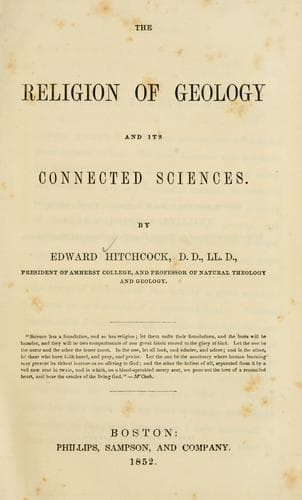
The Religion of Geology and Its Connected SciencesHitchcock, Edward
Religion
The Religion of Geology and Its Connected Sciences
Hitchcock, Edward
Bible and geology; Religion and science
The prevailing opinion in this country, probably, has been, and still is,
that the destruction of the world described by Peter will amount to
annihilation--that the matter of the globe will cease to be. But in all
ages there have been many who believe that the destruction will be only
the ruin of the present economy of the world, but not its utter
extinction. And surely Peter's description does not imply annihilation of
the matter of the globe. He makes fire the agent of the destruction, and,
in order to ascertain the extent of the ruin that will follow, we have
only to inquire what effect combustion will have upon matter. The common
opinion is, that intense combustion actually destroys or annihilates
matter, because it is thereby dissipated. But the chemist knows that not
one particle of matter has ever been thus deprived of existence; that fire
only changes the form of matter, but never annihilates it. When solid
matter is changed into gas, as in most cases of combustion, it seems to be
annihilated, because it disappears; but it has only assumed a new form,
and exists as really as before. Since, therefore, biblical and scientific
truth must agree, we may be sure that the apostle never meant to teach
that the matter of the globe would cease to be, through the action of fire
upon it; nor is there any thing in his language that implies such a
result, but most obviously the reverse.
If these things be so, then, in the third place, we may infer that Peter
did not mean to teach that the matter of the globe would be in the least
diminished by the final conflagration. I doubt not the sufficiency of
divine power partially or wholly to annihilate the material universe. But
heat, however intense, has no tendency to do this; it only gives matter a
new form. And heat is the only agency which the apostle represents as
employed. In short, we have no evidence, either from science or
revelation, that the minutest atom of matter has ever been destroyed since
the original creation; nor have we any more evidence that any of it ever
will be reduced to the nothingness from which it sprang. The prevalent
ideas upon this subject all result from erroneous notions of the effect of
intense heat.
In the fourth place, the passage under consideration teaches us that
whatever upon or within the earth is capable of combustion will undergo
that change, and that the entire globe will be melted.
The language of Peter has always seemed to me extremely interesting. He
says that _the heavens_ [or atmosphere] _will pass away with a great
noise, and the elements shall melt with fervent heat; the earth, also, and
the works that are therein, shall be burned up; looking for, and hasting
unto the coming of the day of God, wherein the heavens, being on fire,
shall be dissolved, and the elements shall melt with fervent heat_.
Public-domain text, read in full here on John Shaqi.
Reviews
Reviews
No reviews yet
Be the first to share your thoughts on this work.
Elsewhere in the archive
Join the Discussion
Join the discussion
Sign in to leave a comment or review.
Sign InorCreate an account