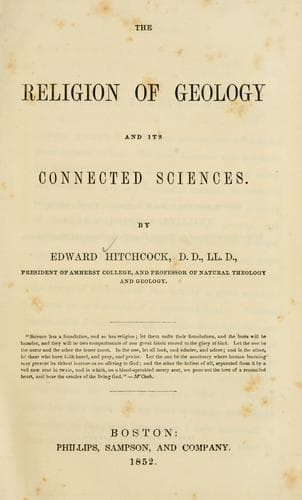
The Religion of Geology and Its Connected SciencesHitchcock, Edward
Religion
The Religion of Geology and Its Connected Sciences
Hitchcock, Edward
Bible and geology; Religion and science
This language approaches nearer to an anticipation of the scientific
discoveries of modern times than any other part of Scripture. And yet, at
the time it was written, it would not have enabled any one to understand
the chemistry of the great changes which it describes. But, now that their
chemistry is understood, we perceive that the language is adapted to it,
in a manner which no uninspired writer would have done. The atmosphere is
represented as passing away with a great noise--an effect which the
chemist would predict by the union of its oxygen with the hydrogen and
other gases liberated by the intense heat. Yet what uninspired writer of
the first century would have imagined such a result?
Again, when we consider the notions which then prevailed, and which are
still widely diffused, why should the apostle add to the simple statement
that the earth would be burnt up, the declaration that its elements would
be melted? For the impression was, that the combustion would entirely
destroy the matter of the globe. But the chemist finds that the greater
part of the earth has already been oxidized, or burnt, and on this matter
the only effect of the heat, unless intense enough to dissipate it, would
be to melt it. If, therefore, the apostle had said only that the world
would be burnt up, the sceptical chemist would have inferred that he had
made a mistake through ignorance of chemistry. But he cannot now draw such
an inference; for the apostle's language clearly implies that only the
combustible matter of the globe will be burnt, while the elements, or
first principles of things, will be melted; so that the final result will
be an entire liquid, fiery globe. Such a wonderful adaptation of his
description to modern science could not surely have resulted from human
sagacity, but must be the fruit of divine inspiration.
And this adaptation is the more wonderful when we find it running through
the whole Bible wherever the sacred writers come in contact with
scientific subjects. In this respect, the Bible differs from every other
system of religion professedly from heaven.
Whenever other systems have treated of the works of nature, they have
sanctioned some error, and thus put into the hands of modern science the
means of detecting the imposture. The Vedas of India adopt the absurd
notions of an ignorant and polytheistic age respecting astronomy, and the
Koran adopts as infallible truth the absurdities of the Ptolemaic system.
But hitherto the Bible has never been proved to come into collision with
any scientific discovery, although many of its books were written in the
rudest and most ignorant ages. It does not, indeed, anticipate scientific
discovery. But the remarkable adaptation of its language to such
discoveries, when they are made, seems to me a more striking mark of its
divine origin than if it had contained a revelation of the whole system of
modern science.
Public-domain text, read in full here on John Shaqi.
Reviews
Reviews
No reviews yet
Be the first to share your thoughts on this work.
Elsewhere in the archive
Join the Discussion
Join the discussion
Sign in to leave a comment or review.
Sign InorCreate an account