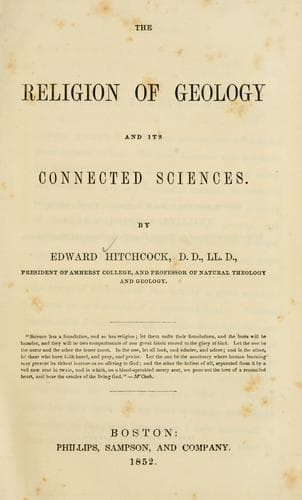
The Religion of Geology and Its Connected SciencesHitchcock, Edward
Religion
The Religion of Geology and Its Connected Sciences
Hitchcock, Edward
Bible and geology; Religion and science
In the passage quoted from Peter, it is said, _Nevertheless, we, according
to his promise, look for new heavens and a new earth, wherein dwelleth
righteousness._ Most writers have supposed the apostle to refer either to
the promise made to Abraham, that his seed should inherit the land, or to
a prophecy in Isaiah, which says, _Behold, I create new heavens, and a new
earth, and the former shall not be remembered, or come into mind. But be
you glad and rejoice forever in that which I create; for behold, I create
Jerusalem a rejoicing, and her people a joy. And I will rejoice in
Jerusalem, and joy in my people; and the voice of weeping shall be no more
heard in her, nor the voice of crying. There shall be no more thence an
infant of days, nor an old man that hath not filled his days; for the
child shall die a hundred years old; but the sinner, being a hundred years
old, shall be accursed. And they shall build houses, and inhabit them; and
they shall plant vineyards, and eat the fruit of them. They shall not
build, and another inhabit; they shall not plant, and another eat; for as
the days of a tree are the days of my people, and mine elect shall long
enjoy the works of their hands. The wolf and the lamb shall feed together,
and the lion shall eat straw like the bullock; and dust shall be the
serpent's meat. They shall not hurt nor destroy in all my holy mountain,
saith the Lord._
Now, it seems highly probable that the new heavens and earth, here
described, represent a state of things on the present earth before the day
of judgment, and not a heavenly and immortal state; for sin and death are
spoken of as existing in it; both which, we are assured, will be excluded
from heaven. Hence able biblical writers refer this prophecy to the
millennial state, or the period when there will be a general prevalence of
Christianity. In this they are probably correct. But some of these
writers, as Low and Whitby, proceed a step farther, and infer that Peter's
description of the new heavens and new earth belong also to the millennial
period; first, because they presume that the apostle referred to this
promise in Isaiah; and secondly, because he uses the same terms, namely,
"new heavens and new earth." But are these grounds sufficient to justify
so important a conclusion? How common it is to find the same words and
phrases in the Bible applied by different writers to different subjects,
especially by the prophets! Even if we can suppose Peter to place the new
heavens and the new earth before the judgment, in despite of his plain
declaration to the contrary, yet there are few who will doubt that the new
heavens and earth described in revelation are subsequent to the judgment
day, so vividly described in the verses immediately preceding.
Public-domain text, read in full here on John Shaqi.
Reviews
Reviews
No reviews yet
Be the first to share your thoughts on this work.
Elsewhere in the archive
Join the Discussion
Join the discussion
Sign in to leave a comment or review.
Sign InorCreate an account