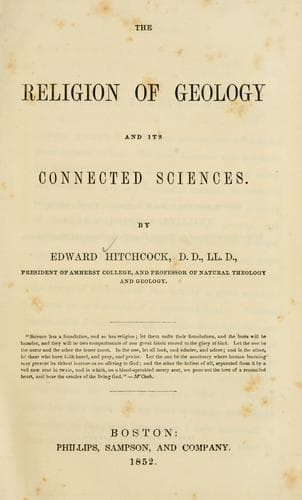
The Religion of Geology and Its Connected SciencesHitchcock, Edward
Religion
The Religion of Geology and Its Connected Sciences
Hitchcock, Edward
Bible and geology; Religion and science
And as to the promise referred to by Peter, if he really describes the
heavenly state, surely it may be found in a multitude of places; wherever,
indeed, immortal life and blessedness are offered to faith and obedience.
Isaiah, therefore, may be giving a figurative description of a glorious
state of the church in this world, under the terms "new heavens and new
earth," emblematical of those real new heavens and new earth beyond the
grave, described by Peter. And hence, it seems to me, the language of the
prophet should not be allowed to set aside, or modify, the plain meaning
of the apostle.
I shall quote only one other passage of the Bible on this subject. I refer
to that difficult text in Romans, which represents the whole creation as
groaning and travailing together in pain until now; and that it will be
delivered from the bondage of corruption into the glorious liberty of the
children of God.
I have stated in a former lecture, that Tholuck, the distinguished German
theologian, considers this a description of the present bound and fettered
condition of all nature, and that the deliverance refers to the future
renovation of the earth. Such an exposition chimes in perfectly with the
views on this subject which have long and extensively prevailed in
Germany. And it certainly does give a consistent meaning to a passage
which has been to commentators a perfect labyrinth of difficulties. If
this be not its meaning, then I may safely say that its meaning has not
yet been found out.
In view, then, of all the important passages of Scripture concerning the
future destruction and renovation of the earth, I think we may fairly
conclude that none of them require us to modify the natural and obvious
meaning of Peter which has been given. In general, they all coincide with
the views presented by that apostle; or if, in any case, there is a slight
apparent difference, the figurative character of all other statements
besides his require us to receive his views as the true standard, and to
modify the meaning of the others. We may, therefore, conclude that the
Bible does plainly and distinctly teach us that this earth will hereafter
be burned up; in other words, that all upon or within it, capable of
combustion, will be consumed, and the entire mass, the elements, without
the loss of one particle of the matter now existing, will be melted; and
then, that the world, thus purified from the contamination of sin, and
surrounded by a new atmosphere, or heavens, and adapted in all respects
to the nature and wants of spiritual and sinless beings, will become the
residence of the righteous. Of the precise nature of that new
dispensation, and of the mode of existence there, the Scriptures are
indeed silent. But that, like the present world, it will be
material,--that there will be a solid globe, and a transparent expanse
around it,--seems most clearly indicated in the sacred record.
Public-domain text, read in full here on John Shaqi.
Reviews
Reviews
No reviews yet
Be the first to share your thoughts on this work.
Elsewhere in the archive
Join the Discussion
Join the discussion
Sign in to leave a comment or review.
Sign InorCreate an account