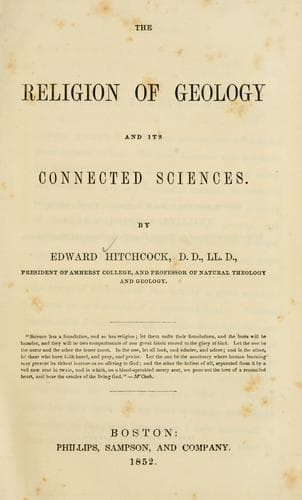
The Religion of Geology and Its Connected SciencesHitchcock, Edward
Religion
The Religion of Geology and Its Connected Sciences
Hitchcock, Edward
Bible and geology; Religion and science
Dr. Knapp, one of the most scientific and judicious of theologians, thus
remarks upon the passage of Peter already examined: "It cannot be thought
that what is here said respecting the burning of the world is to be
understood figuratively, as Wettstein supposes; because the fire is here
too directly opposed to the literal water of the flood to be so
understood. It is the object of Peter to refute the boast of scoffers,
that all things had remained unchanged from the beginning, and that,
therefore, no day of judgment and no end of the world could be expected.
And so he says that originally, at the time of the creation, the whole
earth was covered and overflowed with water, (Gen. i.,) and that from
hence the dry land appeared; and the same was true at the time of Noah's
flood. But there is yet to come a great fire revolution. The heavens and
the earth (the earth with its atmosphere) are reserved, or kept in store,
for the fire, until the day of judgment, (v. 10.) At that time the heavens
will pass away with a great noise, and the elements will be dissolved by
fervent heat, and every thing upon the earth will be burnt up. The same
thing is taught in verse 12. But in verse 13 Peter gives the design of
this revolution. It will not be annihilation, but we expect a new heavens
and a new earth, wherein dwelleth righteousness, _i. e._, an entirely new,
altered, and beautiful abode for man, to be built from the ruins of his
former dwelling-place, as the future habitation of the pious, (Rev. xxi.
1.) This will be very much in the same way as a more perfect and an
immortal body will be reared from the body which we now
possess."--_Theology_, vol. ii. p. 649.
From Dr. Chalmers my extracts will be longer than are necessary to show
his opinion upon this subject, because he felicitously refutes certain
erroneous ideas, widely prevalent, respecting matter, and spirit. "We know
historically," says he, "that earth, that a solid, material earth, may
form the dwelling of sinless creatures, in full converse and friendship
with the Being who made them." "Man, at the first, had for his place this
world, and, at the same time, for his privilege an unclouded fellowship
with God, and for his prospect an immortality, which death was neither to
intercept nor put an end to. He was terrestrial in respect to condition,
and yet celestial, both in respect of character and enjoyments.
Public-domain text, read in full here on John Shaqi.
Reviews
Reviews
No reviews yet
Be the first to share your thoughts on this work.
Elsewhere in the archive
Join the Discussion
Join the discussion
Sign in to leave a comment or review.
Sign InorCreate an account