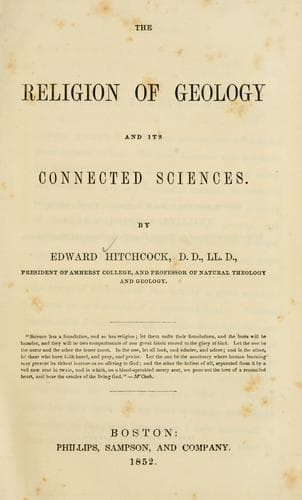
The Religion of Geology and Its Connected SciencesHitchcock, Edward
Religion
The Religion of Geology and Its Connected Sciences
Hitchcock, Edward
Bible and geology; Religion and science
The wide-spread opinion that heaven will be a sort of airy Elysium, where
the present laws of nature will be unknown, and where matter, if it exist,
can exist only in its most attenuated form, is a notion to which the Bible
is a stranger.
The resurrection of the body, as well as the language of Peter, most
clearly show us that the future world will be a solid, material world,
purified indeed, and beautified, but retaining its materialism.
Let us now see whether, in coming to these conclusions from Scripture
language, we are influenced by scientific considerations, or whether many
discerning minds have not, in all ages, attached a similar meaning to the
inspired record.
Among all nations, the history of whose opinions have come down to us, and
especially among the Greeks, the belief has prevailed that a catastrophe
by fire awaited the earth, corresponding to, or rather the counterpart of,
a previous destruction by water. These catastrophes they denominated the
_cataclysm_, or destruction by water, and the _ecpyrosis_, or destruction
by fire. The ruin was supposed to be followed, in each case, by the
regeneration of the earth in an improved form, which gradually
deteriorated; the first age after the catastrophe, constituting the golden
age; the next, the silver age; and so on to the iron age, which preceded
another cataclysm, or ecpyrosis. The intervals between these convulsions
were regarded as of various lengths, but all of them of great duration.
These opinions the Greeks derived from the Egyptians.
The belief in the future conflagration of the world also prevailed among
the ancient Jews. Philo says that "the earth, after this purification,
shall appear new again, even as it was after its first creation."--_De
Vita Mosis_, tom. ii.--Among the Jews, these ideas may have been, in part,
derived from the Old Testament; though its language, as we have seen, is
far less explicit on this subject than the New Testament. That
distinguished Christian writers, in all ages since the advent of Christ,
have understood the language of Peter as we have explained it, would be
easy to show. I have room, however, to quote only the opinions of a few
distinguished modern writers.
Public-domain text, read in full here on John Shaqi.
Reviews
Reviews
No reviews yet
Be the first to share your thoughts on this work.
Elsewhere in the archive
Join the Discussion
Join the discussion
Sign in to leave a comment or review.
Sign InorCreate an account