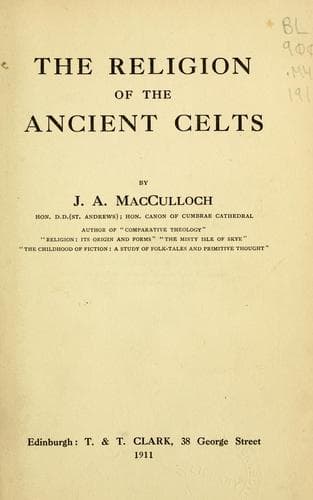
The Religion of the Ancient CeltsMacCulloch, J. A. (John Arnott)
Religion
The Religion of the Ancient Celts
MacCulloch, J. A. (John Arnott)
Celts -- Religion; Mythology, Celtic
As Cúchulainn grew up, his strength, skill, wisdom, and beauty were
unsurpassed. All women fell in love with him, and to forestall a series
of _bonnes fortunes_, the men of Ulster sought a wife for him. But the
hero's heart was set on Emer, daughter of Forgall, whom he wooed in a
strange language which none but she could understand. At last she
consented to be his wife if he would slay a number of warriors. Forgall
was opposed to the match, and with a view to Cúchulainn's destruction
suggested that he should go to Donall in Alba to increase his skill, and
to Scathach if he would excel all other warriors. He agreed, provided
that Forgall would give him whatever he asked for on his return. Arrived
in Alba, he refused the love of Donall's daughter, Dornolla, who swore
to be avenged. Thence he went to Scathach, overcoming all the dangers of
the way, leaping in safety the gulf surrounding her island, after
essaying in vain to cross a narrow, swinging bridge. From Scathach he
learned supreme skill in arms, and overcame her Amazonian rival Aife. He
begat a son by Aife, and instructed her to call him Conla, to give him
his father's ring, to send him to seek Cúchulainn, and to forbid him to
reveal his name. In the sequel, Cúchulainn, unaware that Conla was his
son, slew him in single combat, too late discovering his identity from
the ring which he wore. This is the well-known saga formula of Sohrab
and Rustum, of Theseus and Hippolytus. On his return from Scathach's
isle Cúchulainn destroyed Forgall's _rath_ with many of its inmates,
including Forgall, and carried off Emer. To the ten years which
followed, during which he was the great champion of Ulster, belong many
tales in which he figures prominently. One of these is _The Debility of
the Ultonians_. This was caused by Macha, who, during her pregnancy, was
forced to run a race with Conchobar's horses. She outran them, but gave
birth immediately to twins, and, in her pangs, cursed the men of Ulster,
with a curse that, in time of oppression, they would be overcome with
the weakness of childbirth. From this Cúchulainn was exempt, for he was
not of Ulster, but a son of Lug.[456] Various attempts have been made to
explain this "debility." It may be a myth explaining a Celtic use of the
"couvade," though no example of a simultaneous tribal couvade is known,
unless we have here an instance of Westermarck's "human pairing season
in primitive times," with its consequent simultaneous birth-period for
women and couvade for men.[457] Others, with less likelihood, explain it
as a period of tabu, with cessation from work and warfare, at a funeral
or festival.[458] In any case Macha's curse is a myth explanatory of the
origin of some existing custom, the duration of which is much
exaggerated by the narrator. To this period belong also the tale of
Cúchulainn's visit to Elysium, and others to be referred to later.
Another story describes his attack upon Morrigan because she would
Public-domain text, read in full here on John Shaqi.
Reviews
Reviews
No reviews yet
Be the first to share your thoughts on this work.
Elsewhere in the archive
Join the Discussion
Join the discussion
Sign in to leave a comment or review.
Sign InorCreate an account