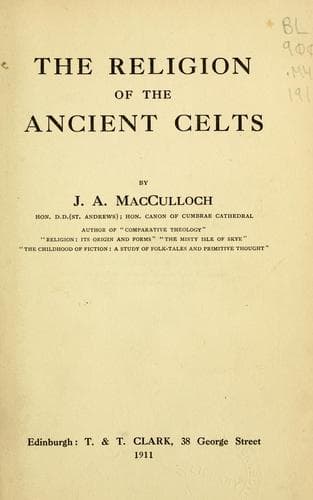
The Religion of the Ancient CeltsMacCulloch, J. A. (John Arnott)
Religion
The Religion of the Ancient Celts
MacCulloch, J. A. (John Arnott)
Celts -- Religion; Mythology, Celtic
neither yield up the cows which she was driving away nor tell her true
name--an instance of the well-known name tabu. Morrigan took the form of
a bird, and was then recognised by Cúchulainn, who poured scorn upon
her, while she promised to oppose him during the fight of the _Táin_ in
the forms of an eel, a wolf, and a cow, all of which he vowed to
destroy.[459] Like many others in the saga, this story is introductory
to the main episode of the _Táin_. To this we now turn.
Medb had been wife of Conchobar, but, leaving him, had married in
succession two chiefs called Ailill, the second of whom had a bull,
Findbennach, the White-horned, which she resolved to match by one in
every way its equal. Having been refused the Brown Bull of Cuailgne, she
summoned all her forces to invade Ulster. The moment was inauspicious
for Ulster, for all its men were suffering from their "debility."
Cúchulainn, therefore, went out to encounter the host, and forced Medb
to agree that a succession of her warriors should engage him in single
combat. Among these was his old friend Ferdia, and nothing is so
touching as his reluctance to fight him or so pathetic as his grief when
Ferdia falls. The reluctance is primarily due to the tie of
blood-brotherhood existing between them. Finally, the Ulstermen rose in
force and defeated Medb, but not before she had already captured the
bull and sent it into her own land. There it was fought by the
Findbennach and slew it, rushing back to Ulster with the mangled body on
its horns. But in its frenzy a rock seemed to be another bull, which it
charged; its brains were dashed out, and it fell dead.
The Morrigan had warned the bull of the approach of Medb's army, and she
had also appeared in the form of a beautiful woman to Cúchulainn
offering him her love, only to be repulsed. Hence she turned against
him, and described how she would oppose him as an eel, a wolf, and a red
heifer--an incident which is probably a variant of that already
described.[460] In each of these shapes she was conquered and wounded by
the hero, and knowing that none whom he hurt could be healed save by
himself, she appeared to him as an old crone milking a cow. At each
draught of the milk which he received from her he blessed her with "the
blessing of gods and not-gods," and so her wounds were healed.[461] For
this, at a later time, she tried to ward off his death, but
unsuccessfully. During the progress of the _Táin_, one of Cúchulainn's
"fairy kinsmen," namely, Lug, who announced himself as his father,
appeared to aid him, while others of the Tuatha Déa threw "herbs of
healing" into the streams in which his wounds were washed.[462]
Public-domain text, read in full here on John Shaqi.
Reviews
Reviews
No reviews yet
Be the first to share your thoughts on this work.
Elsewhere in the archive
Join the Discussion
Join the discussion
Sign in to leave a comment or review.
Sign InorCreate an account