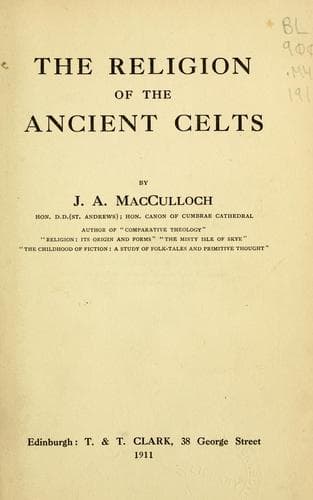
The Religion of the Ancient CeltsMacCulloch, J. A. (John Arnott)
Religion
The Religion of the Ancient Celts
MacCulloch, J. A. (John Arnott)
Celts -- Religion; Mythology, Celtic
Another theory is that every visit of the hero to a strange land
signifies a descent to Hades, suggested by the sun sinking in the west.
Scathach's island may be Hades, but it is more probably Elysium with
some traits borrowed from the Christian idea of hell. But Emer's land,
also visited by Cúchulainn, suggests neither Hades nor Elysium. Emer
calls herself _ingen rig richis garta_, translated by Professor Rh[^y]s
as "daughter of the coal-faced king," i.e. she is daughter of darkness.
Hence she is a dawn-maiden and becomes the sun-hero's wife.[478] There
is nothing in the story to corroborate this theory, apart from the fact
that it is not clear, even to the hypothetical primitive mind, why dawn
and sun should be a divine pair. Emer's words probably mean that she is
"daughter of a king" and "a flame of hospitality" (_richis garta_.)[479]
Cúchulainn, in visiting her, went from west to east, contrary to the
apparent course of the sun. The extravagance of the solar theory is
further seen in the hypothesis that because Cúchulainn has other wives,
the sun-god made love to as many dawn-maidens as there are days in the
year,[480] like the king in Louys' romance with his 366 wives, one for
each day of the year, leap-year included.
Further examples of the solar theory need not be cited. It is enough to
see in Cúchulainn the ideal warrior, whose traits are bombastic and
obscure exaggerations of actual custom and warfare, or are borrowed from
folk-tale _motifs_ not exclusively Celtic. Possibly he may have been a
war-god, since he is associated with Badb[481] and also with Morrigan.
But he has also some traits of a culture hero. He claims superiority in
wisdom, in law, in politics, in the art of the _Filid_, and in Druidism,
while he brings various things from the world of the gods[482]. In any
case the Celts paid divine honours to heroes, living or dead,[483] and
Cúchulainn, god or ideal hero, may have been the subject of a cult. This
lends point to the theory of M. D'Arbois that Cúchulainn and Conall
Cernach are the equivalents of Castor and Pollux, the Dioscuri, said by
Diodorus to be worshipped among the Celts near the Ocean.[484]
Cúchulainn, like Pollux, was son of a god, and was nursed, according to
some accounts, by Findchoém, mother of Conall,[485] just as Leda was
mother of Castor as well as of Pollux. But, on the other hand,
Cúchulainn, unlike Pollux, was mortal. M. D'Arbois then identifies the
two pairs of heroes with certain figures on an altar at Cluny. These are
Castor and Pollux; Cernunnos and Smertullos. He equates Castor with
Cernunnos, and Pollux with Smertullos. Smertullos is Cúchulainn, and the
name is explained from an incident in the _Táin_, in which the hero,
reproached for his youth, puts on a false beard before attacking
Morrigan in her form as an eel. This is expressed by _smérthain_, "to
attach", and is thus connected with and gave rise to the name
Smertullos. On the altar Smertullos is attacking an eel or serpent.
Public-domain text, read in full here on John Shaqi.
Reviews
Reviews
No reviews yet
Be the first to share your thoughts on this work.
Elsewhere in the archive
Join the Discussion
Join the discussion
Sign in to leave a comment or review.
Sign InorCreate an account