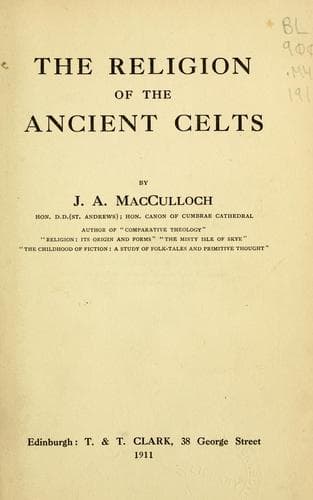
The Religion of the Ancient CeltsMacCulloch, J. A. (John Arnott)
Religion
The Religion of the Ancient Celts
MacCulloch, J. A. (John Arnott)
Celts -- Religion; Mythology, Celtic
existence has been moulded by Celtic religious belief and ritual
practice.[467]
It was inevitable that the "mythological school" should regard
Cúchulainn as a solar hero. Thus "he reaches his full development at an
unusually early age," as the sun does,[468] but also as do many other
heroes of saga and _Märchen_ who are not solar. The three colours of
Cúchulainn's hair, dark near the skin, red in the middle, golden near
the top, are claimed to be a description of the sun's rays, or of the
three parts into which the Celts divided the day.[469] Elsewhere his
tresses are yellow, like Prince Charlie's in fact and in song, yet he
was not a solar hero. Again, the seven pupils of his eyes perhaps
"referred to the days of the week."[470] Blindness befell all women who
loved him, a reference to the difficulty of gazing at the sun.[471] This
is prosaic! The blindness was a compliment paid to Cúchulainn the blind,
by women who made themselves blind while talking to him, just as Conall
Cernach's mistresses squinted as he did.[472] Cúchulainn's blindness
arose from his habit of sinking one eye into his head and protruding the
other--a well-known solar trait! His "distortion," during which, besides
this "blindness," blood shot upwards from his head and formed a magic
mist, and his anger caused showers of sparks to mount above him, points
to dawn or sunset,[473] though the setting sun would rather suggest a
hero sinking calmly to rest than a mad giant setting out to slaughter
friend and foe. The "distortion," as already pointed out, is the
exaggerated description of the mad warrior rage, just as the fear which
produced death to those who saw him brandish his weapons, was also
produced by Maori warrior methods.[474] Lug, who may be a sun-god, has
no such "distortion." The cooling of the hero in three vats, the waters
of which boil over, and his emergence from them pinky red in colour,
symbolise the sun sinking into the waters and reappearing at dawn.[475]
Might it not describe in an exaggerated way the refreshing bath taken by
frenzied warriors, the water being supposed to grow warm from the heat
of their bodies?[476] One of the hero's _geasa_ was not to see
Manannan's horses, the waves; which, being interpreted, means that the
sun is near its death as it approaches the sea. Yet Lug, a sun-god,
rides the steed Enbarr, a personification of the waves, while Cúchulainn
himself often crossed the sea, and also lived with the sea-god's wife,
Fand, without coming to grief. Again, the magic horses which he drives,
black and grey in colour, are "symbols of day and night,"[477] though it
is not obvious why a grey horse should symbolise day, which is not
always grey even in the isles of the west. Unlike a solar hero, too,
Cúchulainn is most active in winter, and rests for a brief space from
slaughtering at midday--the time of the sun's greatest activity both in
summer and winter.
Public-domain text, read in full here on John Shaqi.
Reviews
Reviews
No reviews yet
Be the first to share your thoughts on this work.
Elsewhere in the archive
Join the Discussion
Join the discussion
Sign in to leave a comment or review.
Sign InorCreate an account