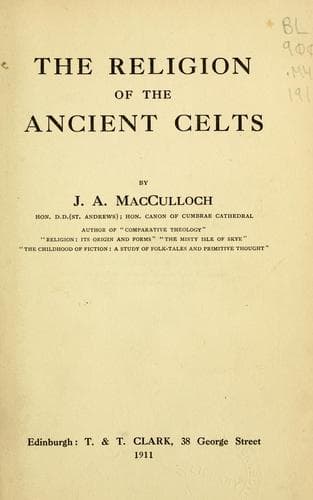
The Religion of the Ancient CeltsMacCulloch, J. A. (John Arnott)
Religion
The Religion of the Ancient Celts
MacCulloch, J. A. (John Arnott)
Celts -- Religion; Mythology, Celtic
rites the animal was slain, not so much as a divine incarnation as a
sacrifice to the god once incarnated in him. And when a god was thus
separated from his animal form, myths often arose telling how he himself
had slain the animal.[502] In the case of Cúchulainn and the bull, the
god represented by the bull became separate from it, became
anthropomorphic, and in that form was associated with or actually was
the hero Cúchulainn. Bull sacrifices were common among the Celts with
whom the bull had been a divine animal.[503] Possibly a further echo of
this myth and ritual is to be found in the folk-belief that S. Martin
was cut up and eaten in the form of an ox--the god incarnate in the
animal being associated with a saint.[504] Thus the literary versions of
the _Táin_, departing from the hypothetical primitive versions, kept the
bull as the central figure, but introduced a rival bull, and described
its death differently, while both bulls are said to be reincarnations of
divine swine-herds.[505] The idea of a fight for a bull is borrowed from
actual custom, and thus the old form of the story was further distorted.
The Cúchulainn saga is more coherent than the Fionn saga, because it
possesses one central incident. The "canon" of the saga was closed at an
early date, while that of Fionn has practically never been closed,
mainly because it has been more a saga of the folk than that of
Cúchulainn. In some respects the two may have been rivals, for if the
Cúchulainn saga was introduced by conquerors from Britain or Gaul, it
would not be looked on with favour by the folk. Or if it is the saga of
Ulster as opposed to that of Leinster, rivalry would again ensue. The
Fionn saga lives more in the hearts of the people, though it sometimes
borrows from the other. This borrowing, however, is less than some
critics, e.g. Zimmer, maintain. Many of the likenesses are the result of
the fact that wherever a hero exists a common stock of incidents becomes
his. Hence there is much similarity in all sagas wherever found.
FOOTNOTES:
[453] _IT_ i. 134; Nutt-Meyer, ii. 38 f.; Windisch, _Táin_, 342; L.
Duvau, "La Legende de la Conception de Cúchulainn," _RC_ ix. 1 f.
[454] Windisch, _Táin_, 118 f. For a similar reason Finnchad was called
Cú Cerca, "the hound of Cerc" (_IT_ iii. 377).
[455] For the boyish exploits, see Windisch, _Táin_, 106 f.
[456] _RC_ vii. 225; Windisch, _Táin_, 20. Macha is a granddaughter of
Ler, but elsewhere she is called Mider's daughter (_RC_ xvi. 46).
[457] Rh[^y]s, _CFL_ ii. 654; Westermarck, _Hist. of Human Marriage_,
ch. 2.
[458] Miss Hull, _Folk-Lore_, xii. 60, citing instances from Jevons,
_Hist. of Religion_, 65.
[459] Windisch, _IT_ ii. 239.
[460] Windisch, 184, 312, 330; cf. _IT_ iii. 355; Miss Hull, 164 f.;
Rh[^y]s, _HL_ 468.
[461] _LL_ 119_a_; _RC_ iii. 175.
[462] Windisch, 342.
[463] _RC_ iii. 175 f.
[464] Ibid. 185.
[465] Crowe, _Jour. Kilkenny Arch. Soc._ 1870-1871, 371 f.
[466] _LL_ 79_a_; O'Curry, _MS. Mat_, 640.
Public-domain text, read in full here on John Shaqi.
Reviews
Reviews
No reviews yet
Be the first to share your thoughts on this work.
Elsewhere in the archive
Join the Discussion
Join the discussion
Sign in to leave a comment or review.
Sign InorCreate an account