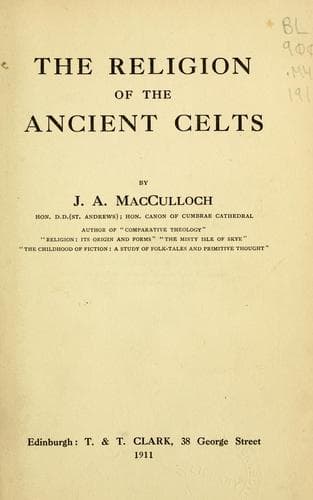
The Religion of the Ancient CeltsMacCulloch, J. A. (John Arnott)
Religion
The Religion of the Ancient Celts
MacCulloch, J. A. (John Arnott)
Celts -- Religion; Mythology, Celtic
The most prominent characters in the Fionn saga, after the death of
Fionn's father Cumal, are Fionn, his son Oisin, his grandson Oscar, his
nephew Diarmaid with his _ball-seire_, or "beauty-spot," which no woman
could resist; Fergus famed for wisdom and eloquence; Caoilte mac Ronan,
the swift; Conan, the comic character of the saga; Goll mac Morna, the
slayer of Cumal, but later the devoted friend of Fionn, besides a host
of less important personages. Their doings, like those of the heroes of
saga and epos everywhere, are mainly hunting, fighting, and love-making.
They embody much of the Celtic character--vivacity, valour, kindness,
tenderness, as well as boastfulness and fiery temper. Though dating from
pagan times, the saga throws little light upon pagan beliefs, but
reveals much concerning the manners of the period. Here, as always in
early Celtdom, woman is more than a mere chattel, and occupies a
comparatively high place. The various parts of the saga, like those of
the Finnish _Kalevala_, always existed separately, never as one complete
epos, though always bearing a certain relation to each other. Lonnrot,
in Finland, was able, by adding a few connecting links of his own, to
give unity to the _Kalevala_, and had MacPherson been content to do this
for the Fionn saga, instead of inventing, transforming, and serving up
the whole in the manner of the sentimental eighteenth century, what a
boon would he have conferred on Celtic literature. The various parts of
the saga belong to different centuries and come from different authors,
all, however, imbued with the spirit of the Fionn tradition.
A date cannot be given to the beginnings of the saga, and additions have
been made to it even down to the eighteenth century, Michael Comyn's
poem of Oisin in Tir na n-Og being as genuine a part of it as any of the
earlier pieces. Its contents are in part written, but much more oral.
Much of it is in prose, and there is a large poetic literature of the
ballad kind, as well as _Märchen_ of the universal stock made purely
Celtic, with Fionn and the rest of the heroic band as protagonists. The
saga embodies Celtic ideals and hopes; it was the literature of the
Celtic folk on which was spent all the riches of the Celtic imagination;
a world of dream and fancy into which they could enter at all times and
disport themselves. Yet, in spite of its immense variety, the saga
preserves a certain unity, and it is provided with a definite framework,
recounting the origin of the heroes, the great events in which they were
concerned, their deaths or final appearances, and the breaking up of the
Fionn band.
Public-domain text, read in full here on John Shaqi.
Reviews
Reviews
No reviews yet
Be the first to share your thoughts on this work.
Elsewhere in the archive
Join the Discussion
Join the discussion
Sign in to leave a comment or review.
Sign InorCreate an account