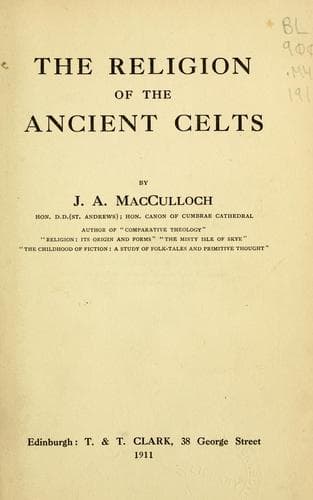
The Religion of the Ancient CeltsMacCulloch, J. A. (John Arnott)
Religion
The Religion of the Ancient Celts
MacCulloch, J. A. (John Arnott)
Celts -- Religion; Mythology, Celtic
Bearing in mind that they are the cherished heroes of popular fancy in
Ireland and the Scottish Highlands, we have now to inquire whether they
were Celtic in origin. We have seen that the Celts were a conquering
people in Ireland, bringing with them their own religion and mythology,
their own sagas and tales reflected now in the mythological and
Cúchulainn cycles, which found a local habitation in Ireland. Cúchulainn
was the hero of a saga which flourished more among the aristocratic and
lettered classes than among the folk, and there are few popular tales
about him. But it is among the folk that the Fionn saga has always been
popular, and for every peasant who could tell a story of Cúchulainn a
thousand could tell one of Fionn. Conquerors often adopt beliefs,
traditions, and customs of the aboriginal folk, after hostilities have
ceased, and if the pre-Celtic people had a popular hero and a saga
concerning him, it is possible that in time it was accepted by the Celts
or by the lower classes among them. But in the process it must have been
completely Celticised, like the aborigines themselves; to its heroes
were given Celtic names, or they may have been associated with existing
Celtic personages like Cumal, and the whole saga was in time adapted to
the conceptions and legendary history of the Celts. Thus we might
account for the fact that it has so largely remained without admixture
with the mythological and Cúchulainn cycles, though its heroes are
brought into relation with the older gods. Thus also we might account
for its popularity as compared with the Cúchulainn saga among the
peasantry in whose veins must flow so much of the aboriginal blood both
in Ireland and the Highlands. In other words, it was the saga of a
non-Celtic people occupying both Ireland and Scotland. If Celts from
Western Europe occupied the west of Scotland at an early date, they may
have been so few in number that their own saga or sagas died out. Or if
the Celtic occupation of the West Highlands originated first from
Ireland, the Irish may have been unable to impose their Cúchulainn saga
there, or if they themselves had already adopted the Fionn saga and
found it again in the Highlands, they would but be the more attached to
what was already localised there. This would cut the ground from the
theory that the Fionn saga was brought to Scotland from Ireland, and it
would account for its popularity in the Highlands, as well as for the
fact that many Fionn stories are attached to Highland as well as to
Irish localities, while many place-names in both countries have a Fian
origin. Finally, the theory would explain the existence of so many
_Märchen_ about Fionn and his men, so few about Cúchulainn.
Public-domain text, read in full here on John Shaqi.
Reviews
Reviews
No reviews yet
Be the first to share your thoughts on this work.
Elsewhere in the archive
Join the Discussion
Join the discussion
Sign in to leave a comment or review.
Sign InorCreate an account