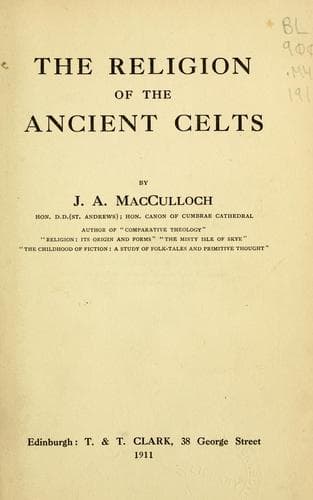
The Religion of the Ancient CeltsMacCulloch, J. A. (John Arnott)
Religion
The Religion of the Ancient Celts
MacCulloch, J. A. (John Arnott)
Celts -- Religion; Mythology, Celtic
Returning to the theory of the historic aspect of the Fians, it should
be noted that, while, when seen through the eyes of the annalists, the
saga belongs to a definite historical period, when viewed by itself it
belongs to a mythic age, and though the Fians are regarded as champions
of Ireland, their foes are usually of a supernatural kind, and they
themselves move in a magic atmosphere. They are also brought into
connection with the unhistoric Tuatha Dé Danann; they fight with them or
for them; they have amours with or wed their women; and some of the gods
even become members of the Fian band. Diarmaid was the darling of the
gods Oengus and Manannan, and in his direst straits was assisted by the
former. In all this we are in the wonderland of myth, not the _terra
firma_ of history. There is a certain resemblance between the Cúchulainn
and Fionn sagas, but no more than that which obtains between all sagas
everywhere. Both contain similar incidents, but these are the stock
episodes of universal saga belief, fitted to the personages of
individual sagas. Hence we need not suppose with Professor Windisch that
the mythic incidents of the Fionn saga are derived from the Cúchulainn
cycle.
The personages against whom Fionn and his men fight show the mythic
nature of the saga. As champions of Leinster they fight the men of
Ulster and Connaught, but they also war against oversea invaders--the
Lochlanners. While Lochlann may mean any land beyond the sea, like the
Welsh _Llychlyn_ it probably meant "the fabulous land beneath the lakes
or the waves of the sea," or simply the abode of hostile, supernatural
beings. Lochlanners would thus be counterparts of the Fomorians, and the
conflicts of the Fians with them would reflect old myths. But with the
Norse invasions, the Norsemen became the true Lochlanners, against whom
Fionn and his men fight as Charlemagne fought Muhammadans--a sheer
impossibility. Professor Zimmer, however, supposes that the Fionn saga
took shape during the Norse occupation from the ninth century onwards.
Fionn is half Norse, half Irish, and equivalent to Caittil Find, who
commanded the apostate Irish in the ninth century, while Oisin and Oscar
are the Norse Asvin and Asgeirr. But it is difficult to understand why
one who was half a Norseman should become the chosen hero of the Celts
in the very age in which Norsemen were their bitter enemies, and why
Fionn, if of Norse origin, fights against Lochlanners, i.e. Norsemen. It
may also be inquired why the borrowing should have affected the saga
only, not the myths of the gods. No other Celtic scholar has given the
slightest support to this brilliant but audacious theory. On the other
hand, if the saga has Norse affinities, and if it is, in origin,
pre-Celtic, these may be sought in an earlier connection of Ireland with
Scandinavia in the early Bronze Age. Ireland had a flourishing
civilisation then, and exported beautiful gold ornaments to Scandinavia,
Public-domain text, read in full here on John Shaqi.
Reviews
Reviews
No reviews yet
Be the first to share your thoughts on this work.
Elsewhere in the archive
Join the Discussion
Join the discussion
Sign in to leave a comment or review.
Sign InorCreate an account