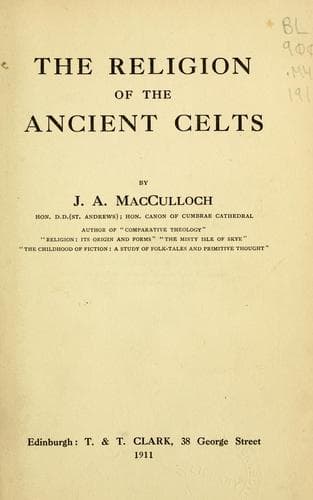
The Religion of the Ancient CeltsMacCulloch, J. A. (John Arnott)
Religion
The Religion of the Ancient Celts
MacCulloch, J. A. (John Arnott)
Celts -- Religion; Mythology, Celtic
The strife of creeds in Ireland, the old order changing, giving place to
new, had evidently impressed itself on the minds of Celtic poets and
romancers. It suggested itself to them as providing an excellent
"situation"; hence we constantly hear of the meeting of gods, demigods,
or heroes with the saints of the new era. Frequently they bow before the
Cross, they are baptized and receive the Christian verity, as in the
_Colloquy_ and in some documents of the Cúchulainn cycle. Probably no
other European folk-literature so takes advantage of just this
situation, this meeting of creeds, one old and ready to vanish away, the
other with all the buoyant freshness of youth.
Was MacPherson's a genuine Celtic epic unearthed by him and by no one
else? No mortal eye save his has ever seen the original, but no one who
knows anything of the contents of the saga can deny that much of his
work is based on materials collected by him. He knew some of the tales
and ballads current among the folk, possibly also some of the Irish MS.
versions. He saw that there was a certain unity among them, and he saw
that it was possible to make it more evident still. He fitted the
floating incidents into an epic framework, adding, inventing, altering,
and moulding the whole into an English style of his own. Later he seems
to have translated the whole into Gaelic. He gave his version to the
world, and found himself famous, but he gave it as the genuine
translation of a genuine Celtic epic. Here was his craft; here he was
the "charlatan of genius." His genius lay in producing an epic which
people were willing to read, and in making them believe it to be not his
work but that of the Celtic heroic age. Any one can write an epic, but
few can write one which thousands will read, which men like
Chateaubriand, Goethe, Napoleon, Byron, and Coleridge will admire and
love, and which will, as it were, crystallise the aspirations of an age
weary with classical formalism. MacPherson introduced his readers to a
new world of heroic deeds, romantic adventure, deathless love, exquisite
sentiments sentimentally expressed. He changed the rough warriors and
beautiful but somewhat unabashed heroines of the saga into sentimental
personages, who suited the taste of an age poised between the bewigged
and powdered formalism of the eighteenth century, and the outburst of
new ideals which was to follow. His _Ossian_ is a cross between Pope's
_Homer_ and Byron's _Childe Harold_. His heroes and heroines are not on
their native heath, and are uncertain whether to mince and strut with
Pope or to follow nature with Rousseau's noble savages and Saint
Pierre's Paul and Virginia. The time has gone when it was heresy to cast
doubt upon the genuineness of MacPherson's epic, but if any one is still
doubtful, let him read it and then turn to the existing versions,
ballads, and tales. He will find himself in a totally different
atmosphere, and will recognise in the latter the true epic note--the
Public-domain text, read in full here on John Shaqi.
Reviews
Reviews
No reviews yet
Be the first to share your thoughts on this work.
Elsewhere in the archive
Join the Discussion
Join the discussion
Sign in to leave a comment or review.
Sign InorCreate an account