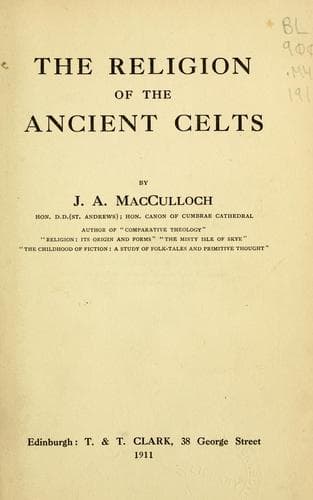
The Religion of the Ancient CeltsMacCulloch, J. A. (John Arnott)
Religion
The Religion of the Ancient Celts
MacCulloch, J. A. (John Arnott)
Celts -- Religion; Mythology, Celtic
warrior's rage and the warrior's generosity, dire cruelty yet infinite
tenderness, wild lust yet also true love, a world of magic
supernaturalism, but an exact copy of things as they were in that
far-off age. The barbarism of the time is in these old tales--deeds
which make one shiver, customs regarding the relations of the sexes now
found only among savages, social and domestic arrangements which are
somewhat lurid and disgusting. And yet, withal, the note of bravery, of
passion, of authentic life is there; we are held in the grip of genuine
manhood and womanhood. MacPherson gives a picture of the Ossianic age as
he conceived it, an age of Celtic history that "never was on sea or
land." Even his ghosts are un-Celtic, misty and unsubstantial phantasms,
unlike the embodied _revenants_ of the saga which are in agreement with
the Celtic belief that the soul assumed a body in the other world.
MacPherson makes Fionn invariably successful, but in the saga tales he
is often defeated. He mingles the Cúchulainn and Ossianic cycles, but
these, save in a few casual instances, are quite distinct in the old
literature. Yet had not his poem been so great as it is, though so
un-Celtic, it could not have influenced all European literature. But
those who care for genuine Celtic literature, the product of a people
who loved nature, romance, doughty deeds, the beauty of the world, the
music of the sea and the birds, the mountains, valour in men, beauty in
women, will find all these in the saga, whether in its literary or its
popular forms. And through it all sounds the undertone of Celtic pathos
and melancholy, the distant echo
"Of old unhappy, far-off things
And battles long ago."
FOOTNOTES:
[506] See Joyce, _OCR_ 447.
[507] Montelius, _Les Temps Préhistoriques_, 57, 151; Reinach, _RC_ xxi.
8.
[508] The popular versions of this early part of the saga differ much in
detail, but follow the main outlines in much the same way. See Curtin,
_HTI_ 204; Campbell, _LF_ 33 f.; _WHT_ iii. 348.
Public-domain text, read in full here on John Shaqi.
Reviews
Reviews
No reviews yet
Be the first to share your thoughts on this work.
Elsewhere in the archive
Join the Discussion
Join the discussion
Sign in to leave a comment or review.
Sign InorCreate an account